Your suppliers are the foundation of your restaurant's quality. A breakdown in the supply chain — a missed delivery, an unauthorised order, an unpaid invoice — can cascade into service failures, food safety issues, and damaged supplier relationships that take months to repair.
Yet restaurant vendor management is one of the most neglected areas of restaurant operations. Most restaurants manage their suppliers through a combination of phone calls, WhatsApp messages, paper invoices, and memory. This is not a system — it is organised chaos.
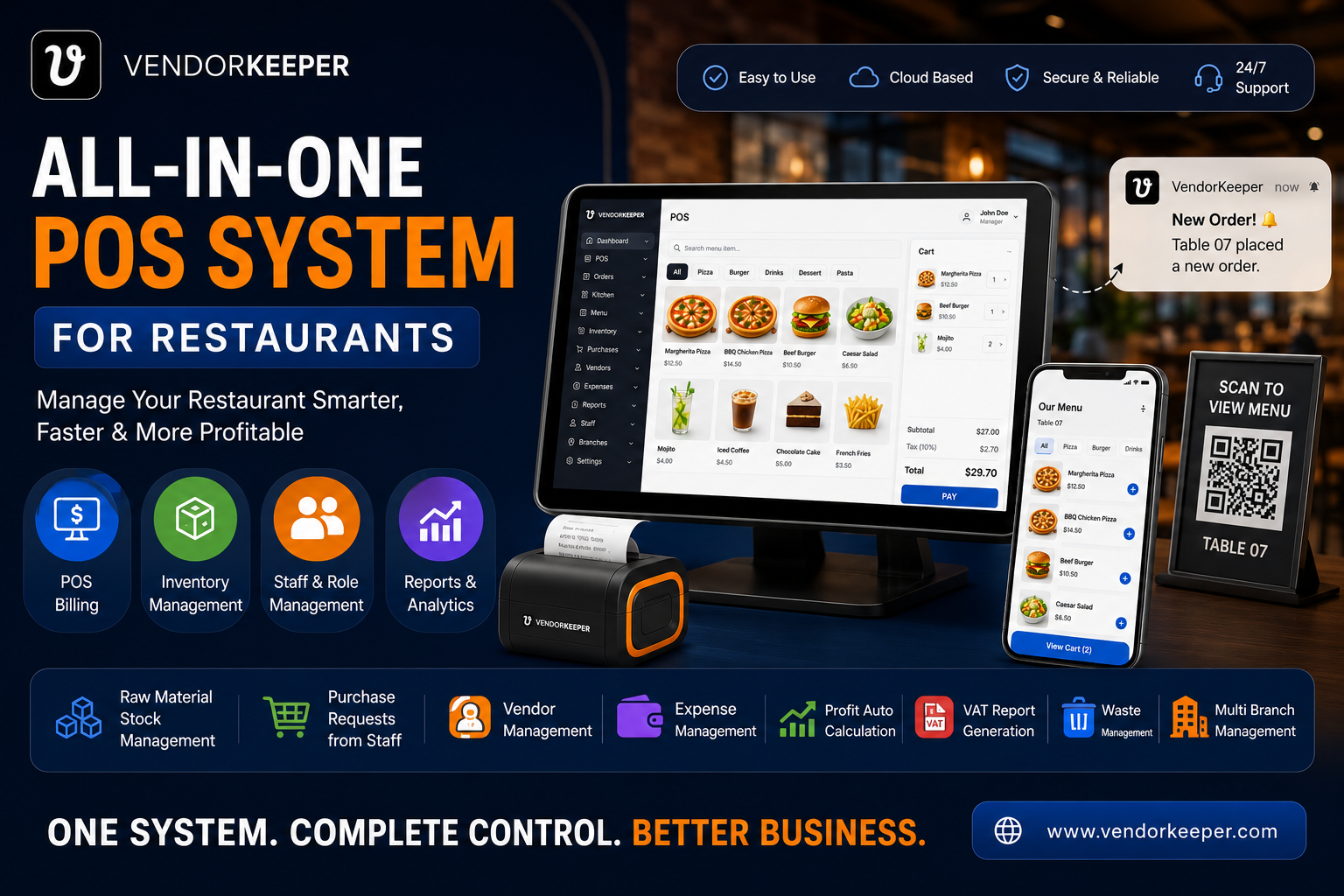
This guide explains how a proper restaurant vendor and supply chain management system works — and why VendorKeeper's integrated vendor module is the competitive advantage that serious restaurant operators are adopting.
The True Cost of Poor Vendor Management
Poor vendor management costs restaurants in four specific ways:
1. Duplicate and unauthorised purchasing: Without a formal approval process, staff order supplies independently — often duplicating orders or purchasing items at retail prices when wholesale alternatives exist. Studies suggest this adds 8–12% to supply costs.
2. Missed due payments: Forgetting a supplier payment damages the relationship and can result in COD terms being enforced — disrupting cash flow.
3. No price comparison: Without purchase history data, restaurants cannot identify when supplier prices have crept up or when competitor quotes would offer better value.
4. Quality accountability gaps: When a delivery of substandard ingredients is accepted without documentation, there is no record to support a claim or complaint to the supplier.
VendorKeeper's Vendor Management Module: A Complete Overview
Supplier Directory
VendorKeeper maintains a complete digital supplier directory — every vendor your restaurant works with, with:
- Contact information (phone, email, address)
- Product categories supplied
- Payment terms (COD, 7 days, 30 days)
- Current outstanding balance
- Account status (active, on hold, preferred)
This replaces the scattered mix of saved phone numbers, business cards, and WhatsApp chats that most restaurants rely on.
Purchase Order Management
VendorKeeper enables digital Purchase Orders (POs) — formal documents that specify what you are ordering, in what quantity, at what price, from which supplier, with what delivery expectation.
POs create a documented record that:
- Holds suppliers accountable for delivery accuracy
- Provides evidence in price disputes
- Creates an audit trail for accounts payable
- Enables three-way matching (PO vs delivery vs invoice)
Staff Purchase Requests & Approval Workflow
This is VendorKeeper's most differentiated vendor feature — and the one that creates the most immediate cost savings.
Without a system: A chef needs 10kg of premium protein. They call the supplier directly and order it. A duplicate order was already placed by the head chef this morning. $150 of over-ordering occurs.
With VendorKeeper: The chef submits a digital purchase request — specifying the item, quantity, and urgency. The system routes it to the manager for review. The manager sees the current stock level and the pending orders from the head chef. The duplicate request is rejected. $150 saved.
The approval workflow is configurable:
- Low-value requests: Cashier → Manager approval
- Medium-value requests: Manager → Director approval
- High-value or premium ingredient requests: Director → Owner approval
Every approval is logged, timestamped, and linked to the resulting PO.
Due Payment Tracking
VendorKeeper tracks every outstanding vendor payment — automatically calculating due dates based on payment terms and flagging overdue amounts.
Management receives:
- Weekly due payment summary: All invoices due in the next 7 days
- Overdue alerts: Push notifications when a payment passes its due date
- Supplier balance dashboard: Total outstanding balance per supplier
This transforms accounts payable from a reactive scramble into a proactive, organised process.
Vendor Transaction History
Every purchase, payment, credit, and return is recorded in VendorKeeper's vendor transaction history. For each supplier, management can see the complete financial relationship:
- Total purchases this month/year
- Average order value
- Payment reliability (on-time vs late payment history)
- Delivery accuracy (quantity ordered vs quantity delivered)
- Price history by item
This data is invaluable for annual supplier negotiations — knowing your exact volume with a supplier gives you the leverage to renegotiate pricing.
Supply Chain Visibility: From Order to Kitchen
VendorKeeper's vendor management connects seamlessly to the inventory module:
- Purchase request submitted by kitchen staff
- Manager reviews and approves (or rejects)
- Purchase Order created and sent to supplier
- Delivery received — quantities recorded, added to inventory
- Invoice matched to PO — discrepancies flagged automatically
- Payment scheduled based on terms — due date tracked
- Ingredient consumed by kitchen sales — stock auto-deducted
This end-to-end visibility means no supply chain event is invisible. Every movement from order to consumption is documented.
Vendor Management for Multi-Branch Restaurant Groups
Multi-branch operators face amplified vendor management complexity:
- Branch A ordering from different suppliers than Branch B for the same ingredients
- Central procurement negotiating group contracts that individual branches then use
- Stock transfers between branches (sourced from centralised purchasing)
VendorKeeper's multi-branch vendor management supports:
- Centralised supplier directory shared across all branches
- Branch-specific purchase requests routing to group management for approval
- Group-level purchasing reports showing total volume across all locations
- Inter-branch stock transfers with full audit trail
FAQs: Restaurant Vendor Management
What is vendor management in a restaurant? Restaurant vendor management is the systematic process of managing supplier relationships — including purchasing, order approval, delivery receipt, invoice management, and payment tracking — to control supply costs and maintain supply chain reliability.
How does an approval workflow prevent unauthorised purchases? VendorKeeper requires every purchase request to be reviewed and approved by a manager before a purchase order is issued. This prevents duplicate orders, unauthorised spending, and purchases at retail prices when wholesale alternatives exist.
Can VendorKeeper track outstanding payments to suppliers? Yes. VendorKeeper tracks every outstanding vendor invoice, calculates due dates based on payment terms, and sends alerts when payments are approaching or overdue.
How much can a restaurant save with better vendor management? Restaurants implementing digital purchase approval workflows typically see 8–15% reductions in supply costs — through elimination of duplicate orders, better price negotiation from purchase history data, and reduced emergency restaurant purchases.
Does VendorKeeper support vendor management for multi-branch restaurants? Yes. VendorKeeper provides a centralised supplier directory shared across branches, with branch-level purchase requests routing to group management for approval — supporting centralised procurement at scale.