VAT compliance is not optional — and for restaurant operators, it is one of the most administratively burdensome aspects of running a business. Whether you operate in Bangladesh (Mushak), the UAE (FTA), the UK (HMRC), or Europe (EU VAT), the consequences of non-compliance range from penalties to prosecution.
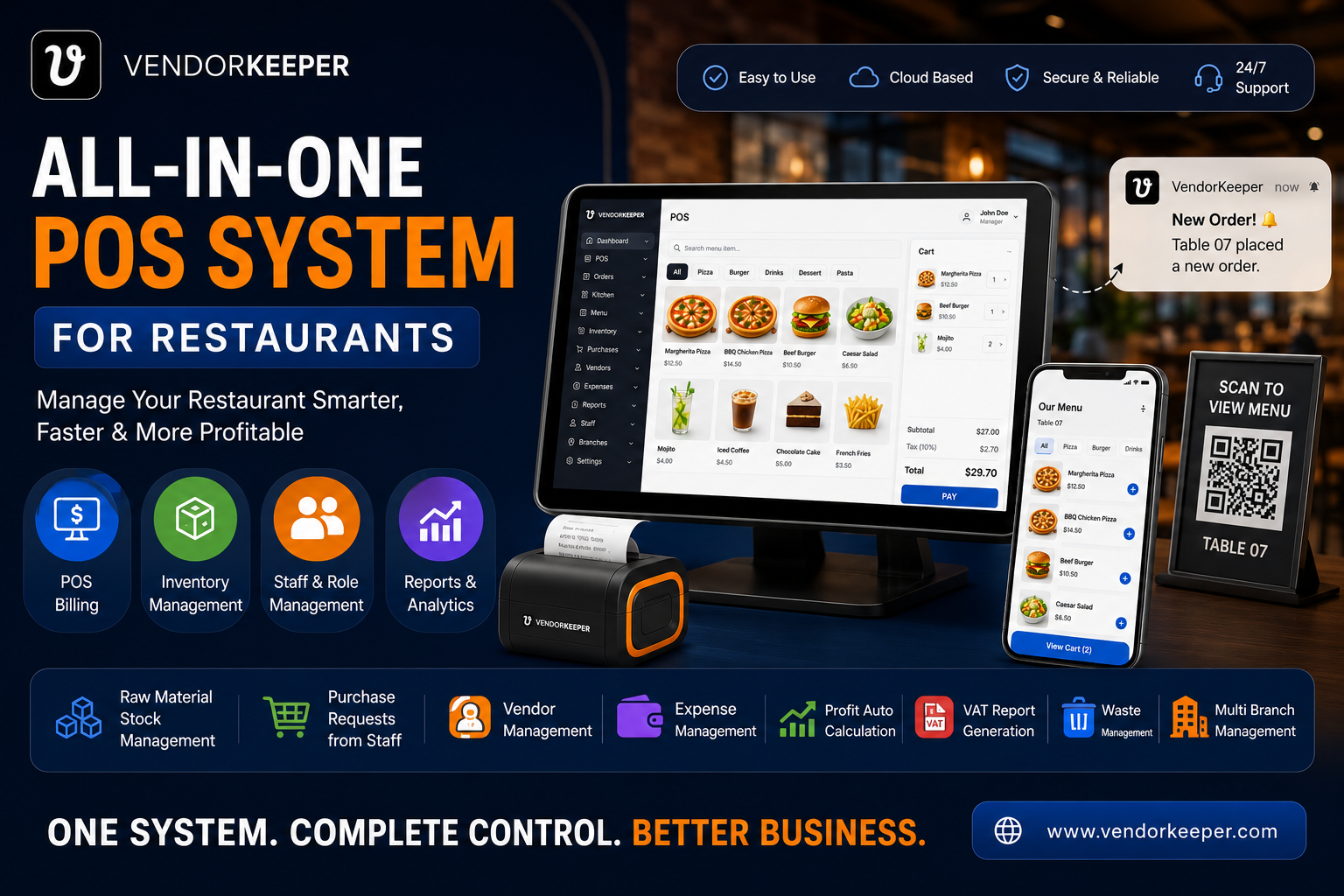
The right restaurant POS system transforms VAT compliance from a monthly nightmare into an automated, one-click process. This guide explains exactly how — and why VendorKeeper's integrated VAT reporting is the most complete solution available for restaurant operators globally.
Why VAT Compliance is Critical for Restaurants
Restaurants are high-transaction businesses. A 100-cover restaurant might process 250 transactions per day — each of which has VAT implications. Manual tracking of this volume is not just impractical; it is a compliance disaster waiting to happen.
The specific risks of poor VAT management in restaurants:
- Under-declaration: Reporting less VAT than is owed — whether intentional or through manual error — results in penalties, back-payment demands, and interest charges
- Invoice non-compliance: Tax invoices that do not meet regulatory format requirements are invalid and cannot be used as evidence of VAT paid
- Audit exposure: Restaurants without automated VAT records are highly vulnerable to revenue authority audits
VAT Requirements by Market
Bangladesh (Mushak)
Bangladesh's NBR requires restaurants above the registration threshold to issue Mushak 6.3 format tax invoices. These include specific fields: seller TIN, buyer TIN (for B2B), VAT registration number, itemised VAT breakdown, and the prescribed invoice format.
VendorKeeper generates fully compliant Mushak 6.3 invoices automatically with every qualifying transaction — and produces the periodic VAT returns required for submission.
UAE (Federal Tax Authority)
The UAE's 5% VAT (introduced 2018) requires FTA-compliant tax invoices for all B2C restaurant transactions above AED 400, and for all B2B transactions. Invoices must include TRN, itemised VAT, and AED-formatted totals.
VendorKeeper generates FTA-compliant invoices automatically and produces VAT reports for quarterly FTA submission.
UK (HMRC)
UK restaurants are required to charge VAT at 20% (standard) or 12.5% (reduced hospitality rate, applicable to certain food items). VAT returns are submitted quarterly via HMRC's Making Tax Digital (MTD) system.
VendorKeeper's configurable VAT module applies the correct rate per item category and generates MTD-ready reports.
EU (Various Rates)
European VAT rates and rules vary by country — from 7% food VAT in Germany to 10% in France to 9% in the Netherlands. VendorKeeper's multi-rate VAT configuration supports different rates per item category and per branch location.
How VendorKeeper Automates Restaurant VAT Compliance
Automatic VAT Calculation Per Transaction
Every transaction in VendorKeeper applies the correct VAT rate to each item automatically — based on your configuration. Food and beverage items can carry different rates. Takeaway vs dine-in can carry different rates. Alcohol vs soft drinks can carry different rates.
Zero manual calculation. The system applies the right rate to the right item, every time.
VAT-Compliant Invoice Generation
Every invoice generated by VendorKeeper — whether printed, emailed, or sent digitally — meets the format requirements of your configured tax jurisdiction. The correct fields, the correct breakdown, the correct formatting — automatically.
VAT Report Generation (PDF/Excel)
At any time — daily, weekly, monthly, or for a custom date range — management can generate a full VAT report from VendorKeeper. The report shows:
- Total taxable sales by VAT rate category
- Total VAT collected by rate
- Total VAT liability for the period
- Transaction-level detail for audit support
One click. Full compliance documentation.
Export for Tax Submission
VendorKeeper VAT reports export to PDF and Excel — ready for submission to your tax authority or accountant. The PDF format is audit-ready; the Excel format can be imported into accounting software or submitted to MTD-compatible tools.
Sales VAT vs Purchase VAT (Input Tax)
For restaurants that purchase ingredients and supplies from VAT-registered vendors, the VAT paid on purchases (input tax) can be offset against VAT collected on sales (output tax). VendorKeeper's purchase management module captures vendor VAT invoices — enabling your accountant to calculate net VAT liability accurately.
VAT Compliance Workflow in VendorKeeper
Daily: Every transaction automatically applies correct VAT. Invoices are generated compliantly. No manual action required.
Monthly: Run the VAT summary report for the month. Review total output tax. Share with your accountant.
Quarterly: Generate the full VAT return report. Export to Excel or PDF. Submit to your tax authority (or pass to your accountant for MTD submission in the UK).
Annually: Pull the full-year VAT history for annual accounts. Everything is already categorised, calculated, and documented.
FAQs: Restaurant VAT Compliance & POS
How does a restaurant POS help with VAT compliance? A POS with integrated VAT management applies correct tax rates automatically to every transaction, generates compliant invoices, and produces periodic VAT reports for submission — eliminating manual calculation errors and audit risk.
Does VendorKeeper support Bangladesh Mushak VAT? Yes. VendorKeeper generates Mushak 6.3 compliant VAT invoices and periodic VAT returns for Bangladesh-registered restaurants.
Can VendorKeeper handle different VAT rates for food and alcohol? Yes. VendorKeeper supports configurable VAT rates per item category — enabling different rates for food, soft drinks, alcohol, and service charges within the same transaction.
Is VendorKeeper compatible with UK Making Tax Digital (MTD)? VendorKeeper generates MTD-ready VAT reports in Excel format that can be used with MTD-compatible filing tools for HMRC submission.
What happens if I have multiple restaurant branches in different VAT jurisdictions? VendorKeeper supports independent VAT configuration per branch — each location can have its own tax rates, invoice format requirements, and reporting currency.