The Complete Guide to Restaurant Management and Kitchen Operations
The restaurant industry is infamous for its razor-thin margins and incredibly high failure rates. In fact, industry statistics show that up to 60% of new restaurants close within their first year, and 80% shut their doors before their fifth anniversary. The reason is rarely the food. Most passionate chefs and food enthusiasts fail not because they cannot cook, but because they struggle to manage the chaotic, fast-moving logistical beast that is back-of-house operations.
Managing a successful restaurant is a delicate dance between front-of-house (FOH) customer hospitality and back-of-house (BOH) kitchen production. If a table order is delayed, if the kitchen runs out of a key ingredient mid-service, or if a cashier enters a wrong order due to poor communication, the dining experience is ruined, and profits leak.
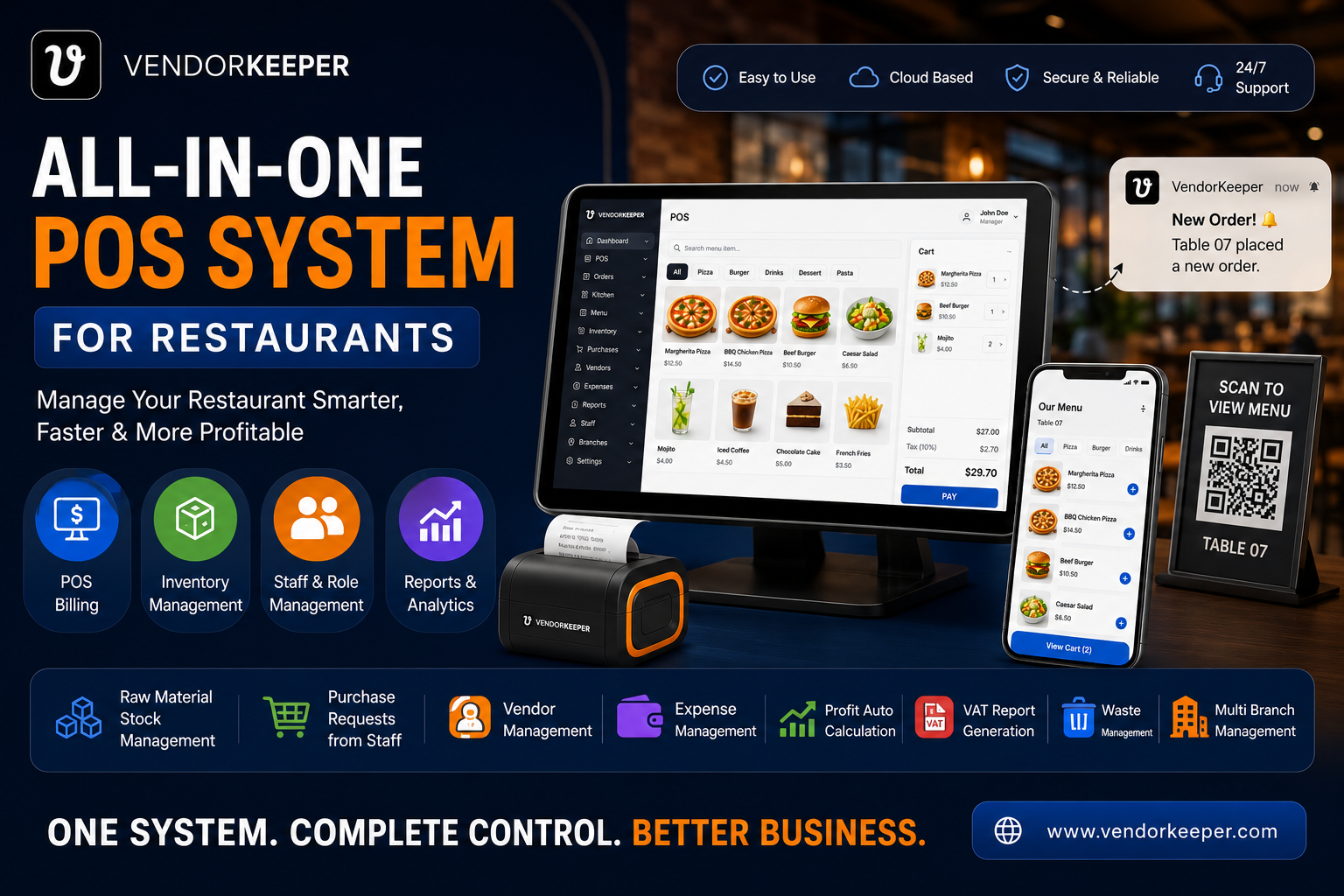
To solve this, modern operators rely on a comprehensive Restaurant Management framework supported by a specialized Restaurant POS system. This guide will outline the core pillars of modern restaurant operations, explore how to optimize kitchen workflows using Kitchen Order Ticket (KOT) logic, and show how VendorKeeper helps you run a highly organized, highly profitable eatery.
The Core Pillars of Restaurant Management
To build a sustainable food business, a restaurant owner must gain absolute control over four key operational areas:
1. Front-of-House (FOH) Service & Order Taking
FOH management is all about speed and accuracy. From the moment guests are seated, your servers must capture their orders quickly. Traditionally, servers wrote orders on paper tickets, walked them over to the kitchen, and hoped the chefs could read their handwriting. This led to multiple points of failure:
- Slow order routing (servers waiting in line to pass paper tickets).
- Misinterpreted modifiers (e.g., "no onions" or "extra spicy" being misread).
- Billing discrepancies when cashier entries did not match kitchen receipts.
2. Kitchen Operations & Order Routing
Once an order is captured, it must be instantly communicated to the kitchen. Modern kitchens are split into specialized stations—grill, cold pantry, fry station, and dessert bar. An order for a steak and a salad should have the steak ticket fire to the grill station and the salad ticket fire to the cold pantry, with both items timed to finish at the exact same moment.
3. Recipe & Raw Material Inventory Management
Inventory control in food service is far more complex than in general restaurant. If you sell a burger, your inventory system cannot just deduct "1 burger." It must deduct 1 bun, 150 grams of beef patty, 20 grams of cheese, 1 slice of tomato, and 10 grams of sauce. This is called ingredient-level inventory tracking. Without it, you cannot calculate your real-time Food Cost Percentage or detect raw material theft by staff.
4. Vendor & Supplier Credit Balances
Restaurants buy perishables (vegetables, meat, dairy) daily from local vendors. Keeping track of cash paid, due credit, invoice receipts, and bulk raw material purchase orders is essential to maintaining a healthy cash flow.
Streamlining Back-of-House with KOT and KDS
The single most effective way to eliminate kitchen chaos is by digitizing your Kitchen Order Ticket (KOT) process. In a digitized system:
- A server takes an order at the table or counter.
- The order is committed to the Restaurant POS.
- KOTs fire instantly: The system prints physical tickets directly on thermal printers located in the kitchen stations, or displays them digitally on a Kitchen Display System (KDS) screen.
- The ticket lists exact table numbers, seat numbers, timestamps, and custom modifiers.
- This reduces average preparation times by up to 35%, completely eliminates shouting and verbal miscommunications, and ensures that every single dish prepared in the kitchen is backed by a registered bill—preventing unpaid "friend-and-family" freebies.
VendorKeeper: The Ultimate Restaurant Management System
If you are looking to take complete control of your restaurant's kitchen, inventory, and sales, VendorKeeper is the all-in-one software platform built for modern restaurateurs.
┌────────────────────────────────────────────────────────┐
│             VENDORKEEPER FOR RESTAURANTS               │
├──────────────────────────┬─────────────────────────────┤
│  Android Play Store App  │  Table-side mobile ordering  │
│  Windows Desktop App     │  Stable counter billing & KDS│
│  Web / Cloud Interface   │  Recipe & ingredient costing │
├──────────────────────────┴─────────────────────────────┤
│  Local-First Offline Mode: Orders fire without internet!│
└────────────────────────────────────────────────────────┘
📱 Mobile Table-Side Ordering (Android Play Store)
With VendorKeeper, your waitstaff do not need to run back and forth between tables and cash registers. The application is fully available as a native Android app that runs smoothly on any smartphone or tablet. Servers can stand at the table, take orders directly, customize dishes with modifiers, and fire KOTs directly to the kitchen in a single tap.
- Download the app directly from the Google Play Store: VendorKeeper on Play Store
🔌 True Offline Operations: Never Lose a Ticket
A restaurant internet drop during a busy Friday night dinner service is a nightmare scenario for cloud-only POS systems—it stops order taking, halts kitchen tickets, and delays customer billing.
VendorKeeper completely solves this with its robust, local-first database architecture. The system works fully in offline mode. If your internet router fails, your servers can still take orders, your cashiers can still print bills, and your KOTs will still print in the kitchen. The local devices communicate seamlessly over your local Wi-Fi router. As soon as the external internet connection is restored, all offline sales data and stock changes sync back to your secure cloud dashboard automatically.
💻 Windows & Web Apps for Heavy Duty Kitchens
For primary reception desks, cashier counters, and large kitchen-mounted display screens, VendorKeeper offers a native, high-performance desktop application for Windows (available on the Microsoft Store) alongside a full-featured cloud dashboard on the Web for back-office recipe management, supplier ledger tracking, and multi-branch reports.
Feature Comparison: How VendorKeeper Empowers Food Operators
| Operational Need | Paper & Legacy Registers | Generic POS Systems | VendorKeeper Restaurant POS |
|---|---|---|---|
| Kitchen Tickets (KOT) | Hand-written (hard to read) | Delayed cloud-reliant routing | Sub-second instant local KOT routing |
| Offline Performance | None | Freezes during internet drops | 100% operational offline-first mode |
| Hardware Flexibility | Proprietary terminal | iPads only | Use standard Android & Windows devices |
| Inventory Tracking | Manual stock book | Package-level only | Ingredient-level recipe deduction |
| Supplier Accounts | Notebook ledger | Missing or basic | Full vendor credit & purchase ledgers |
| Digital QR Menu | None | High-cost third-party integration | Built-in, zero-cost QR table ordering |
4 Keys to Maximizing Kitchen Profitability
To turn your kitchen into a highly efficient, highly profitable operation using VendorKeeper, implement these four best practices:
- Conduct Ingredient Costing: Input your recipes into VendorKeeper down to the exact gram. This allows the system to calculate your precise gross margin per menu item, helping you identify which dishes are driving profits and which need a price adjustment.
- Implement KOT Workflows: Stop using verbal orders. Ensure that every drink, appetizer, and dessert is sent via KOT. This keeps your inventory and financial records perfectly aligned and holds your staff accountable.
- Log Wastage Daily: Food waste happens. Whether a chef burns a steak or a vegetable spoils, log the raw materials in VendorKeeper's waste module. Tracking this data helps you optimize your ordering quantities and reduce food waste by 20–30%.
- Use Mobile Billing at the Table: During busy dinner hours, print the customer's receipt and process payments directly at the table using an Android tablet or phone. This increases your table turnover rate, meaning you can serve more guests in the same amount of time.
Frequently Asked Questions (FAQs)
What is the difference between a KOT and a KDS?
A Kitchen Order Ticket (KOT) is a printed or digital slip containing order details sent from the POS to the kitchen. A Kitchen Display System (KDS) is a digital screen mounted on the kitchen wall that replaces paper KOTs, allowing chefs to view active orders, track preparation times, and mark dishes as complete digitally. VendorKeeper supports both KOT printing and KDS setups.
How does ingredient-level inventory tracking work?
Ingredient-level inventory tracking allows you to link menu items to a specific bill of materials. For example, when a customer orders a pizza, VendorKeeper automatically deducts the correct amounts of flour, cheese, tomato sauce, and pepperoni from your raw stock, giving you real-time visibility into your inventory levels.
Does VendorKeeper work if my restaurant loses internet access?
Yes. VendorKeeper's local-first architecture ensures that your restaurant's billing, order taking, and kitchen ticket printing continue to function flawlessly in offline mode during internet outages. Once the internet connection is restored, all data automatically syncs back up to the cloud servers.
Can I manage multiple restaurant branches with one system?
Yes. VendorKeeper provides a powerful multi-branch dashboard. Owners can monitor sales reports, transfer inventory between different branches, standardise recipe costs, and manage staff permissions across multiple restaurant locations from a single cloud-based account.
Conclusion
Managing a successful kitchen requires balancing creativity with operational discipline. You cannot afford to lose your hard-earned margins to order errors, inventory waste, or system outages.
By upgrading to a modern, offline-capable, and multi-platform Restaurant POS system like VendorKeeper, you gain absolute control over your kitchen logistics, front-of-house service, and inventory. Download the VendorKeeper Android application from the Google Play Store today, or set up our Windows and Web applications to take complete control of your restaurant's future!