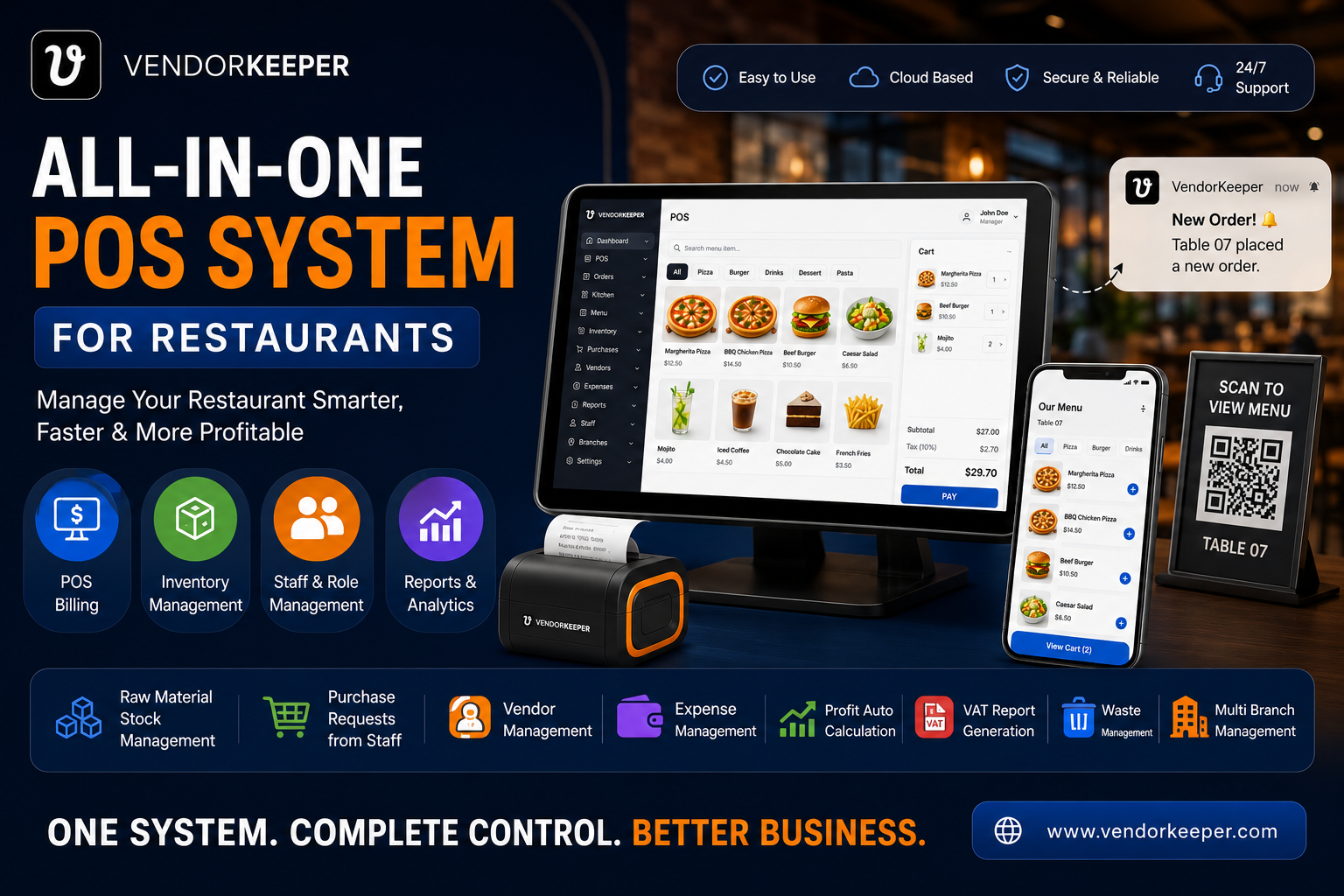
How to Maximize Profit Margins with Advanced Sales Report Analytics
In the world of small and medium business management, there is a classic business saying: "If you cannot measure it, you cannot manage it." Every single day, your restaurant or restaurant processes dozens or hundreds of transactions. Each customer checkout, item scanned, discount applied, and wholesale payment made generates a valuable trail of digital data. Unfortunately, the vast majority of restaurant owners ignore this data, treating their point-of-sale system as a glorified cash register rather than a powerful business intelligence engine.
If you only look at your total daily revenue at the end of the day, you are missing the vital operational clues that separate high-growth, highly profitable brands from businesses that barely break even.
To maximize your profit margins and eliminate hidden operational costs, you must master the art of analyzing your Sales Report.
In this comprehensive guide, we will explore the critical financial metrics every restaurant owner should track, explain how to turn raw transactional data into actionable Shop Management decisions, and show how VendorKeeper gives you the industry's Best POS system reporting tools to scale your business.
Moving Beyond "Gross Revenue": The True Indicators of Profitability
When most owners review their daily operations, they ask a simple question: "How much money did we make today?" While gross revenue is an important metric, it only tells half the story. To understand the true health of your restaurant or restaurant, you must dive deeper into your POS analytics and track these four advanced financial metrics:
1. Cost of Goods Sold (COGS) and Gross Margin
Gross revenue is what your customers pay you. Cost of Goods Sold (COGS) is what it actually cost you to purchase or produce those items.
- The Formula:
Gross Revenue - COGS = Gross Profit - Gross Margin Percentage:
(Gross Profit / Gross Revenue) * 100
If your restaurant sells a product for $100, but it cost you $70 to source it from your wholesaler, your gross profit is $30, and your gross margin is 30%. If your supplier raises their prices and you do not adjust your retail price, your gross revenue might stay the same, but your gross profit will shrink. A modern sales report calculates these margins automatically for every single transaction.
2. Average Transaction Value (ATV)
ATV (also known as Basket Size) measures the average amount of money a customer spends during a single visit.
- The Formula:
Total Revenue / Total Number of Transactions = Average Transaction Value
If your store makes $1,000 in sales from 100 customers, your ATV is $10. If you can train your staff to upsell, or group related products together, and raise your ATV to $12, your total revenue increases to $1,200 with the exact same number of customers—instantly boosting your profitability.
3. Product Performance & Menu Engineering
Every business operates on the Pareto Principle (the 80/20 rule): 80% of your sales are driven by 20% of your products. A detailed sales report ranks your products by both popularity (volume sold) and profitability (gross margin). This allows you to categorize your inventory into four groups:
- Stars: High volume, high profit. (Promote these items heavily!)
- Plowhorses: High volume, low profit. (Try raising the price or sourcing cheaper alternatives.)
- Puzzles: Low volume, high profit. (Improve their marketing or menu placement.)
- Dogs: Low volume, low profit. (Remove them from your shelves or menu entirely.)
4. Hourly Sales Distribution
Understanding when your store makes the most sales is critical for labor optimization. If your sales reports show that 60% of your transactions occur between 5 PM and 8 PM, you can schedule your best staff during those peak hours to ensure fast service, and run targeted discounts during slow morning hours to drive traffic.
VendorKeeper: The Ultimate Analytics & Reporting Command Center
To leverage the power of advanced business analytics without needing a degree in finance, you need a system that translates complex numbers into simple, visual, and actionable charts. VendorKeeper is designed to do exactly that.
┌────────────────────────────────────────────────────────┐
│               VENDORKEEPER SALES REPORTS               │
├──────────────────────────┬─────────────────────────────┤
│  Android Play Store App  │  Check real-time reports     │
│                          │  from your smartphone 24/7   │
│  Windows Desktop App     │  Counter analytics dashboard │
│  Web / Cloud Interface   │  Deep-dive CSV/Excel exports │
├──────────────────────────┴─────────────────────────────┤
│  Local-First Offline Sync: Sales log without internet! │
└────────────────────────────────────────────────────────┘
📱 Real-Time Smartphone Reports (Android App)
You do not need to be physically present at your store's checkout counter to know how your business is performing. VendorKeeper is fully available as a native Android app that you can download directly from the Play Store. Whether you are at home, traveling, or managing a second branch, you can open the app on your smartphone and check your real-time Sales Report in seconds.
- Get the Android app on the Google Play Store: VendorKeeper on Play Store
🔌 True Offline Reliability: Never Lose a Transaction
What happens to your sales reports if your store's internet connection drops mid-day? With generic cloud-only POS systems, transactions are either blocked, or they fail to sync, leading to corrupt financial records and missing sales data.
VendorKeeper features a highly advanced, local-first database architecture. The software works fully in offline mode. Even if your store is completely offline due to a network outage, cashiers can continue to process checkouts, calculate discounts, and print bills. The app securely logs every transaction in the local device's memory. The moment your internet connection is restored, the offline sales data automatically syncs with the secure cloud servers, ensuring your daily sales report is 100% accurate and complete.
💻 Windows & Web Apps for Deep-Dive Analysis
For detailed financial audits, inventory checks, and accounting integrations, VendorKeeper offers a high-performance desktop app for Windows (available on the Microsoft Store) along with a comprehensive cloud portal on the Web that allows you to export your data into clean PDF and Excel formats for your accountants.
Feature Comparison: VendorKeeper Analytics vs. Legacy Cash Registers
| Analytical Metric | Paper Journals / Cash Registers | Generic Cloud POS | VendorKeeper POS |
|---|---|---|---|
| Real-time Profit Calculation | Manual daily tally (takes hours) | Cloud-only (stops offline) | Instant local-to-cloud profit tracking |
| Average Ticket Value (ATV) | Impossible to calculate | Basic stats | Visual daily, weekly, & monthly ATV trends |
| Inventory Shrinkage Reports | Missing | Basic stock counts | Discrepancy logs & waste cost tracking |
| Supplier Balance Analytics | Notebook tracking (unreliable) | Usually missing | Built-in vendor credit ledger & reports |
| Multi-store Consolidation | Requires physical travel | High-cost tier | Included centralized owner dashboard |
| Offline Transaction Sync | Local ledger | Lost or corrupt data | Automatic offline-to-cloud restoration |
4 Actionable Strategies to Boost Margins Using Your Sales Reports
Once you set up VendorKeeper, use these four proven data-driven strategies to increase your business's profitability:
- Optimize Your Product Mix: Run a product performance report at the end of every month. Identify your "Dogs" (slow-selling, low-margin items) and clear them out with a promotional sale. Replace them with high-margin "Stars" to maximize your shelf space profit.
- Train Staff to Increase ATV: Use VendorKeeper's staff tracking to monitor the Average Transaction Value generated by individual cashiers or servers. Reward the staff members who consistently generate higher ticket values through successful upselling.
- Control Vendor Purchase Costs: Link your sales reports to your VendorKeeper supplier ledger. When a supplier raises their wholesale cost, check how it affects your gross margin. If your margin drops below your target threshold, use the data to negotiate a better bulk rate or adjust your retail price.
- Schedule Staff Based on Traffic Patterns: Analyze your hourly sales distribution report in VendorKeeper. If you notice a consistent lull on Tuesday mornings, reduce your cashier staff to save on labor costs. Conversely, ensure your checkout counters are fully staffed during peak weekend hours to keep lines moving and maximize transaction volume.
Frequently Asked Questions (FAQs)
What is the most important metric in a restaurant sales report?
While total sales revenue is important, the most critical metric is Gross Margin Percentage. This tells you what percentage of every dollar earned is actually profit after accounting for the cost of sourcing the inventory. VendorKeeper calculates this metric in real-time, giving you an accurate picture of your store's profitability.
Can I view my sales reports when I am away from my shop?
Yes. VendorKeeper's secure cloud database synchronizes all your transaction data automatically. You can download the native VendorKeeper Android app from the Google Play Store or log in via any Web browser to check live sales reports, stock levels, and staff activity from anywhere in the world.
What happens to my sales records if my POS device crashes or breaks?
Because VendorKeeper uses a secure cloud-sync architecture, all your transaction logs, product files, and customer databases are continuously backed up in real-time. If a checkout terminal computer or phone physically breaks, simply download the app on a new device, log in with your credentials, and your entire database will restore instantly.
How does a POS help detect employee theft?
VendorKeeper provides a secure, role-based access control system. Cashiers cannot edit past transactions, apply unauthorized discounts, or delete sales records without manager approval. Additionally, every action (such as opening the cash drawer, applying a discount, or voiding a sale) is logged with a staff timestamp, which you can audit in your sales reports.
Conclusion
Succeeding in the modern cafés and restaurants industry requires moving away from guesswork and adopting a data-driven approach to business operations.
By upgrading to an advanced, multi-platform, and offline-capable Restaurant POS system like VendorKeeper, you gain absolute visibility into your profit margins, sales trends, inventory health, and staff performance. Stop running your business in the dark. Download the VendorKeeper Android application from the Google Play Store today, or set up our Windows and Web applications to transform your store's data into delicious profit!