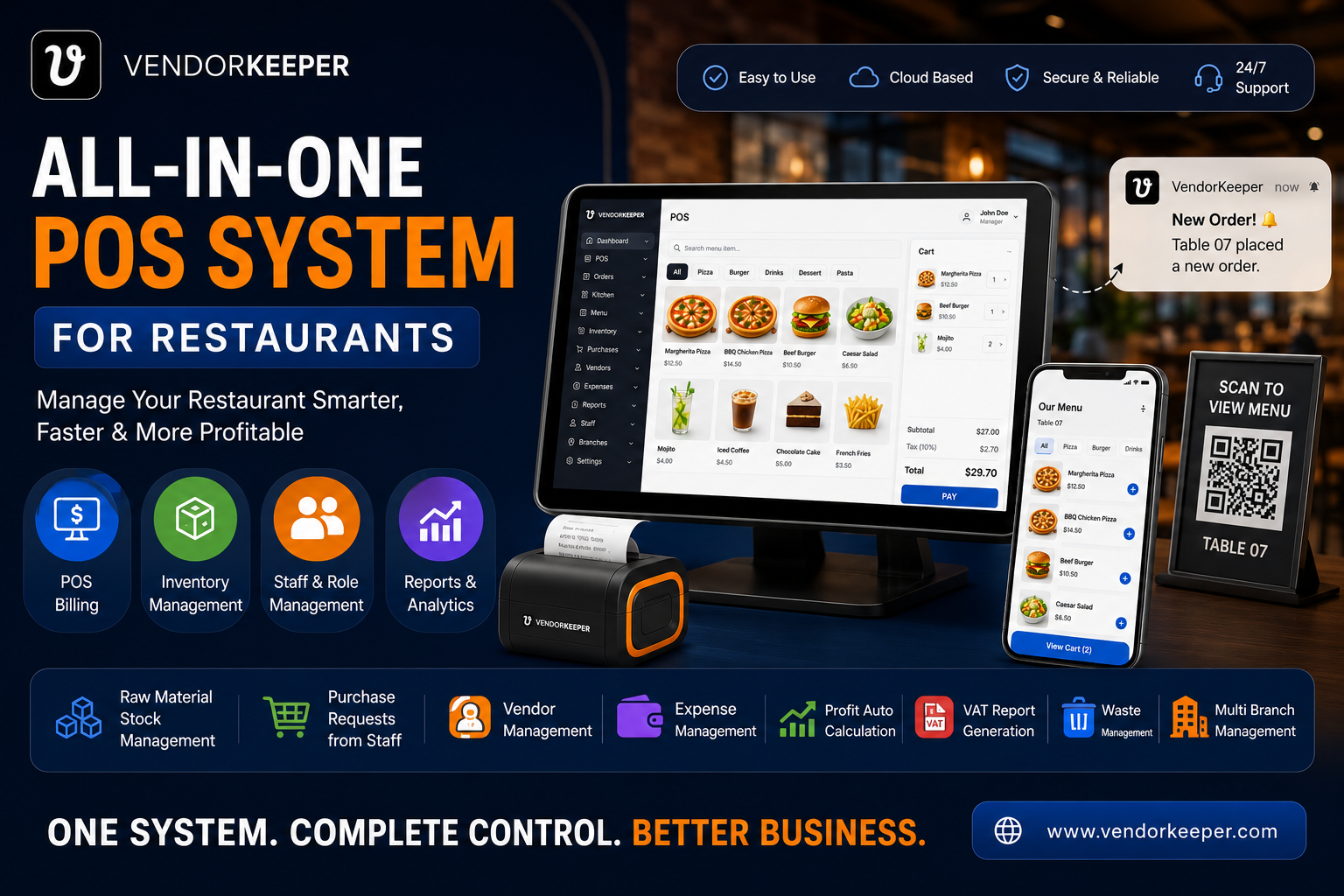
If you have ever worked a busy restaurant service, you know the chaos that lives between the moment a server takes an order and the moment the food leaves the kitchen. Shouted orders, paper tickets lost under the pass, misheard modifications — this is the epicentre of restaurant error and waste.
Kitchen Order Tickets (KOT) and Kitchen Display Systems (KDS) are the technologies that eliminate this chaos. This guide explains exactly how they work, which your restaurant needs, and how VendorKeeper's integrated KOT and kitchen display turns kitchen chaos into kitchen precision.
What is a Kitchen Order Ticket (KOT)?
A Kitchen Order Ticket (KOT) is a printed or digital record of a customer's order that is sent to the kitchen the moment it is placed at the POS. In traditional systems, this was a paper slip. In modern restaurants, it is a digital transmission to a kitchen display screen.
A KOT contains:
- Table number (or takeaway/delivery reference)
- Items ordered with modifications and special instructions
- Quantity per item
- Order time (for ticket time tracking)
- Priority (if rush orders are flagged)
What is a Kitchen Display System (KDS)?
A Kitchen Display System is a screen mounted in the kitchen that receives and displays KOTs digitally. Instead of printing paper tickets that get lost, wet, burned, or torn — the KDS shows a live queue of all pending orders on a screen that every kitchen section can see.
Modern KDS features include:
- Colour-coded urgency (new, in-progress, ready)
- Section routing (starters screen, mains screen, desserts screen)
- Ticket time tracking (how long each order has been waiting)
- Order completion confirmation (marking items done as they are plated)
KOT vs KDS: Which Does Your Restaurant Need?
The answer depends on your operation:
| Feature | Printed KOT | Digital KDS |
|---|---|---|
| Cost | Low (printer only) | Moderate (screen + software) |
| Reliability | Paper jams, burns, tears | Digital — no physical failure modes |
| Visibility | One cook at a time | Entire kitchen simultaneously |
| Ticket tracking | Manual (look at the pile) | Automatic (timestamps, colour coding) |
| Multi-section routing | Requires multiple printers | Configurable per screen |
| Environmentally friendly | No (paper waste) | Yes |
| Integration with analytics | None | Full — ticket times, item counts |
For most restaurants in 2026, a digital KDS is the superior choice. VendorKeeper supports both printed KOT and digital kitchen display — configurable to your preference.
How VendorKeeper's KOT System Works
Instant Order Transmission
The moment a server confirms an order at the POS — or a guest places a QR self-order — VendorKeeper transmits the KOT to the kitchen instantly. No delay. No printing lag. No lost-in-transit paper.
Multi-Station Routing
VendorKeeper routes different order components to the appropriate kitchen station:
- Starters go to the cold section
- Mains go to the grill/hot section
- Desserts fire only when the mains are complete
- Bar drinks go to the bar display
Each section sees only the items relevant to them — reducing cognitive load and errors.
Ticket Time Tracking
Every KOT in VendorKeeper is timestamped from the moment the order is placed. The kitchen display shows how long each ticket has been waiting — colour-coded:
- Green: Under target time (e.g., 12 minutes)
- Amber: Approaching target
- Red: Exceeded target — this table needs attention
This real-time visibility allows kitchen management to spot bottlenecks as they happen — not after service when it is too late.
Order Completion & Pickup Notification
When a section marks its component of an order complete, VendorKeeper automatically notifies the relevant server that the dish is ready for pickup. No shouting across the pass. No food sitting under the lamps while a server is at another table.
The Impact of KOT on Restaurant Performance
The data on KOT adoption is consistent across restaurant types and markets:
- Ticket times reduce by 25–35% — because orders are received instantly and sections start immediately
- Order error rates fall by 60–80% — because every instruction is written, visible, and acknowledged
- Kitchen staff satisfaction improves — the chaos and shouting that define high-stress services is replaced by calm, digital organisation
- Table turnover increases by 10–15% — because food arrives faster, guests finish sooner, tables reset quicker
KOT for Specific Restaurant Types
QSR & Fast Food: KOT ensures the order taken at the counter is in the kitchen before the customer has finished paying. Speed is the only metric — KOT delivers it.
Full Service Restaurants: Multi-section routing ensures starters arrive before mains fire, desserts are perfectly timed, and no section is waiting on information from another.
Delivery Kitchens: KOT sequence management ensures delivery orders are prioritised and ready for collection on time — critical for maintaining platform ratings.
Hotel F&B: Multiple outlets (restaurant + bar + room service) can all receive KOTs from a centralised POS — with each outlet's kitchen display showing only its relevant orders.
FAQs: Kitchen Order Tickets & Kitchen Display Systems
What is a KOT in a restaurant? A Kitchen Order Ticket (KOT) is a digital or printed record of a customer's order sent to the kitchen the moment it is placed. It includes table number, items, quantities, modifications, and timestamp.
Is a kitchen display better than a KOT printer? For most restaurants, yes. A kitchen display shows all active orders simultaneously, tracks ticket times automatically, routes items to specific sections, and eliminates paper waste and printing failures.
How does VendorKeeper handle multiple kitchen stations? VendorKeeper routes each component of an order to the appropriate kitchen station display — starters to the cold section, mains to the hot section, desserts to the pastry section — based on your configuration.
Does VendorKeeper KOT work with QR self-ordering? Yes. Orders placed through VendorKeeper's QR menu appear on the kitchen display exactly the same as server-entered POS orders — instant, complete, and with all modifications included.
How much does a Kitchen Display System cost with VendorKeeper? VendorKeeper's KDS functionality is included as a core feature — no additional module cost. Hardware can be any Android tablet mounted in the kitchen, costing far less than proprietary KDS hardware.