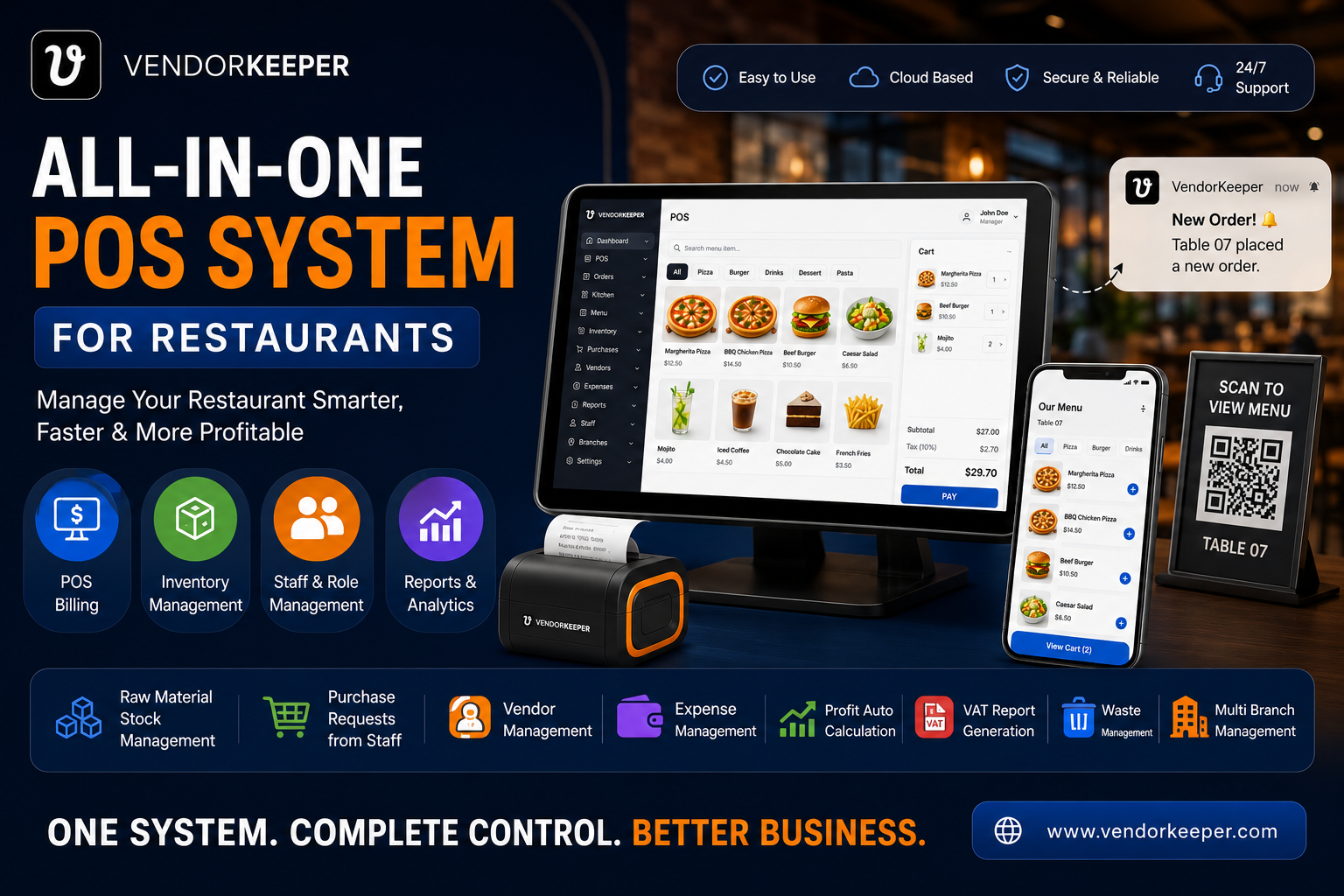
How to Generate and Analyze a Daily Sales Report for Your Small Business
For any small or medium enterprise (SME) owner, the daily closing routine is one of the most critical moments of the business day. As you pull down the shutters of your restaurant or restaurant, you need to answer a series of fundamental financial questions: How much revenue did we pull in today? Did the register's actual cash match our system records? Which items were our best-sellers? How much tax or VAT did we collect? And ultimately, did we make a profit today, or did we lose money?
In the past, finding these answers required hours of exhausting manual labor. Store owners had to manually tally paper sales receipts, count physical cash drawers, calculate item unit costs, and manually record the summary into a physical cash book or "Tally ledger."
This manual method is slow and highly prone to error. By the time a bookkeeping mistake is discovered days later, it is almost impossible to trace the root cause.
To save time, eliminate calculation mistakes, and protect your cash flow, you must automate this process by utilizing your Point of Sale (POS) system to generate a daily Sales Report.
In this comprehensive guide, we will explore the essential components of a daily sales report, outline a step-by-step framework to analyze your store's daily performance, and show how VendorKeeper gives you the industry's Best POS system reporting dashboard to optimize your Shop Management.
What is a Daily Sales Report?
A daily sales report is an automatically compiled, real-time financial ledger of all commercial transactions processed during a 24-hour business cycle. It compiles your store's raw transactional activities into a clean, easy-to-read summary.
A comprehensive daily sales report must contain these five core sections:
1. Revenue & Payment Summaries
A breakdown of your gross sales, total discounts given to customers, net sales, and a clear distribution of payment methods:
- Cash: The physical cash collected in your register.
- Card: Credit or debit card payments.
- Mobile Money / Digital Wallets: Local digital payments (such as bKash, Nagad, or Apple Pay).
This payment breakdown is essential for "reconciliation"—ensuring that your bank deposits and physical cash drawer match your system records exactly.
2. Cost of Goods Sold (COGS) and Net Profit
Revenue is only vanity; profit is sanity. Your sales report should automatically cross-reference items sold with their wholesale unit purchase costs to calculate your Cost of Goods Sold (COGS) and display your exact Gross Profit and profit margin.
3. Tax / VAT Tracking
Every legal business must collect and report local taxes or Value Added Tax (VAT). Your sales report tracks the precise amount of tax collected across standard, flat-rate, or tax-exempt categories, simplifying your monthly tax filing.
4. Hourly Sales Distribution and Peak Performance
A visual chart displaying your sales volume hourly. This reveals when your store experiences the highest traffic, allowing you to optimize employee shift schedules.
5. Cash Drawer Audit Trails (Float and Drops)
To prevent internal employee theft, your daily report must log the "Cash Float" (the starting cash in the drawer) and "Cash Drops" (cash removed mid-day for safety), comparing the system's expected cash balance against the cashier's physical count at the end of the shift.
Reconciling Your Register: The End-of-Day Workflow
Reconciling your daily register is the single most important task to prevent cash shrinkage. Train your staff to follow this simple 3-step closing workflow:
                  STEP 1: COUNT PHYSICAL CASH DRAWER
                     (Count every note and coin)
                                  │
                  STEP 2: RUN VENDORKEEPER Z-REPORT
                 (View system's expected cash balance)
                                  │
                  STEP 3: IDENTIFY CASH DISCREPANCIES
              (System Cash vs. Physical Cash = Variance)
If the variance is zero, your registers are perfectly balanced. If there is a negative variance (cash short), it indicates cashier change-making mistakes or internal theft. If positive (cash over), it shows cashiers forgot to give correct change.
VendorKeeper: The Definitively Smart SME Analytics POS
Designed to translate complex transaction numbers into simple, visual, and actionable dashboards, VendorKeeper brings enterprise-grade business intelligence reporting to independent cafés and restaurants owners worldwide.
┌────────────────────────────────────────────────────────┐
│               VENDORKEEPER REPORT CENTER               │
├──────────────────────────┬─────────────────────────────┤
│  Android Play Store App  │  Check live sales & cash    │
│                          │  balances from your phone   │
│  Windows Desktop App     │  Counter cash reconciliation│
│  Web / Cloud Interface   │  Deep-dive custom dates     │
│                          │  and multi-branch summaries │
├──────────────────────────┴─────────────────────────────┤
│  100% Reliable Offline Sync: Sales log without network!│
└────────────────────────────────────────────────────────┘
📱 Real-Time Mobile Analytics (Android Play Store App)
You do not need to be physically present at your store's cash counter to monitor your daily closing routine. VendorKeeper is fully available as a native Android app that you can download directly from the Play Store. Whether you are at home, traveling, or managing a separate branch, you can open the app on your phone and check your real-time daily Sales Report in seconds.
- Download the app on Google Play Store: VendorKeeper on Play Store
🔌 True Offline Operations: Reconcile Without Internet
What happens to your daily sales logs if your store experiences a complete internet outage right at closing time? With generic cloud-only POS systems, your cashiers cannot run Z-reports, check expected cash balances, or close out their shifts, stalling your operations.
VendorKeeper completely solves this with its local-first database architecture. The software works fully in offline mode. Cashiers can continue to run end-of-day cash reconciliations, audit cash drawers, and print shift closing summaries without any active internet connection. The data is securely saved in the device's local memory and automatically uploads to your centralized cloud database as soon as a network connection is restored.
💻 Windows & Web Apps for Creative Back-Offices
For administrative tasks, generating custom date-range reports, exporting tax spreadsheets for your accountant, and tracking supplier payments, VendorKeeper offers a native desktop application for Windows (available on the Microsoft Store) alongside a comprehensive cloud control portal on the Web.
Feature Comparison: VendorKeeper Analytics vs. Legacy Bookkeeping
| Daily Reporting Metric | Paper Books / Ledger | Generic Cloud POS | VendorKeeper POS |
|---|---|---|---|
| End-of-day Profit Calc | Manual math (takes hours) | Cloud-only (stops offline) | Instant local-to-cloud profit tracking |
| Payment Type Breakdown | Manual counting | Basic stats | Visual payment logs (cash, card, mobile) |
| Cash Drawer Discrepancy | Hard to detect | Optional add-on | Integrated float & variance logs |
| Tax / VAT Reports | Manual receipts tally | Basic tax column | One-click tax & Mushak compliance reports |
| Multi-branch tracking | Requires physical travel | High-cost tier | Included centralized owner dashboard |
| Offline Shift Closure | Manual entry | Lost or locked data | Automatic offline-to-cloud restoration |
4 Actionable Strategies to Maximize Margins Using Daily Sales Reports
Use these four proven data-driven strategies in VendorKeeper to optimize your business's profitability:
- Audit Drawer Variances Daily: Do not tolerate consistent cash drawer discrepancies. If a cashier consistently registers a negative variance, it indicates a need for retraining or closer supervision. Addressing this early protects your cash flow.
- Optimize Staffing Based on Hourly Sales: Analyze your hourly sales distribution report weekly. If you notice a consistent sales lull on Tuesday mornings, reduce your cashier staff to save on labor costs. Conversely, ensure your registers are fully staffed during peak weekend hours.
- Monitor Gross Margin Trends: Keep a close eye on your Gross Margin Percentage. If your supplier raises their wholesale cost and you do not adjust your retail price, your revenue might stay the same, but your profit will shrink. Use the sales report to track these margin trends in real-time.
- Schedule VIP Promos During Slow Hours: Identify your slowest daily sales hours from your reports. Set up custom happy hour discounts or bulk bundle promotions during these slow periods to drive traffic and maximize sales volume.
Frequently Asked Questions (FAQs)
What is a Z-report in a POS system?
A Z-report is a final, end-of-day financial summary generated by a POS system when a cashier closes their register shift. It permanently resets the daily transaction counters, compiles all sales, taxes, discounts, and payment methods, and logs the final cash balance for reconciliation.
Can I view my daily sales reports when I am away from my shop?
Yes. VendorKeeper's secure cloud database synchronizes all your transaction data automatically. You can download the native VendorKeeper Android app from the Google Play Store or log in via any Web browser to check live sales reports, stock levels, and staff activity from anywhere in the world.
What happens to my sales records if my computer crashes?
Because VendorKeeper uses a secure cloud-sync architecture, all your transaction logs, product files, and customer databases are continuously backed up in real-time. If a checkout terminal computer or phone physically breaks, simply download the app on a new device, log in with your credentials, and your entire database will restore instantly.
Can I export my sales reports for accounting software?
Yes. VendorKeeper provides comprehensive export options. You can filter your sales reports by custom date ranges, branches, or product categories, and export the data into clean PDF or CSV/Excel formats for seamless integration with local accounting systems or audit reviews.
Conclusion
Succeeding in the modern cafés and restaurants industry requires moving away from guesswork and adopting a data-driven approach to business operations.
By upgrading to an advanced, multi-platform, and offline-capable Restaurant POS system like VendorKeeper, you gain absolute visibility into your profit margins, sales trends, inventory health, and staff performance. Stop running your business in the dark. Download the VendorKeeper Android application from the Google Play Store today, or set up our Windows and Web applications to transform your store's data into delicious profit!