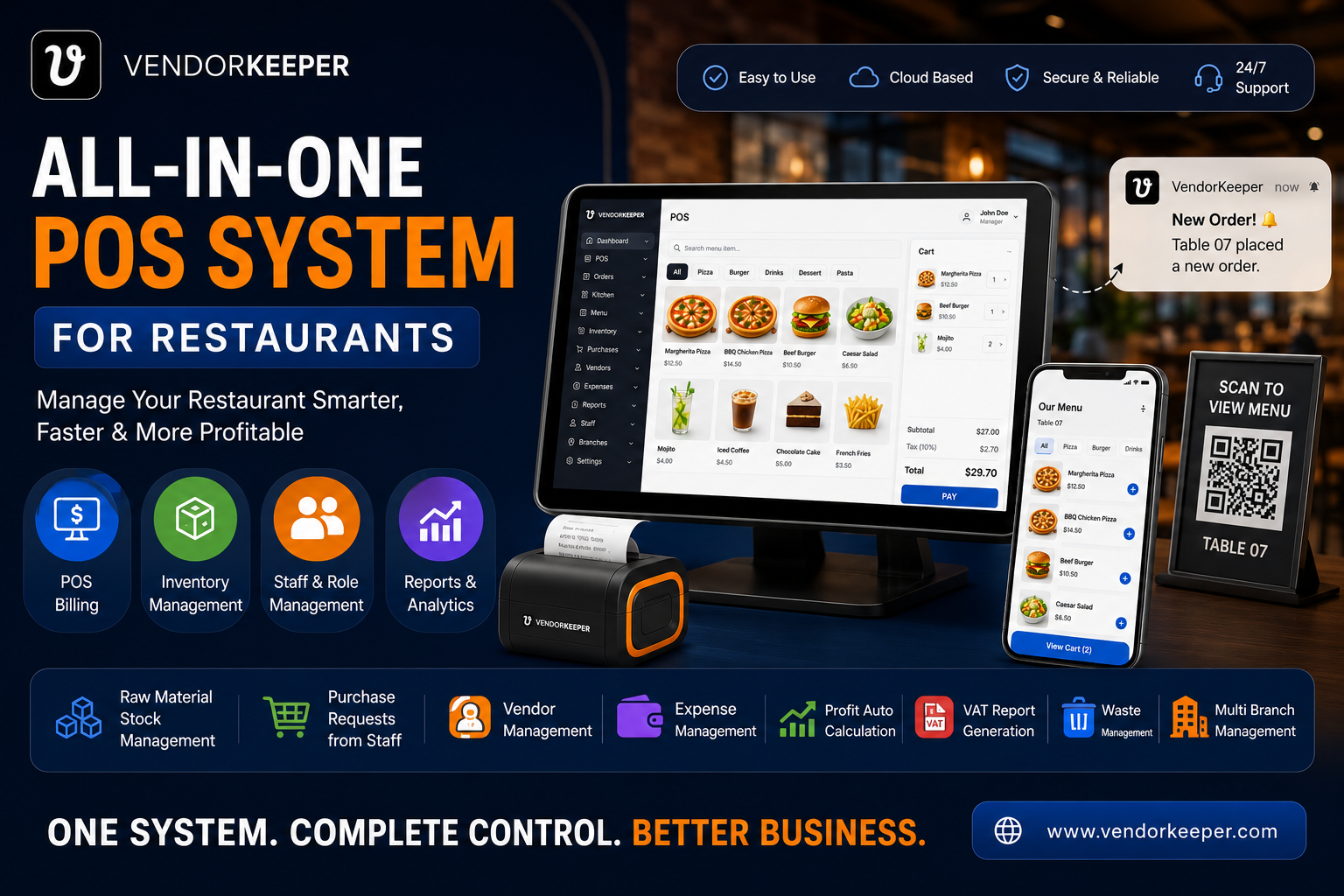
The Evolution of Shop Management: Moving from Cash Registers to Smart POS
Every decade, technology fundamentally reshapes the way we do business. In cafés and restaurants operations, the core mechanism of transaction handling has undergone a remarkable historical transformation. For over a century, the primary tool of checkout administration was the physical cash register—a heavy, mechanical box designed to ring up prices, hold currency, and print a basic paper slip.
When it was invented in the late 19th century, the mechanical cash register was a revolutionary device. It prevented employee cash drawer theft and standardized business operations.
However, in today's high-speed, hyper-competitive, and data-driven market, a legacy cash register is no longer an asset—it is an operational bottleneck that actively drains your store's profits.
Modern restaurant requires a unified, intelligent command center that connects your sales directly with your inventory tracking, raw material costing, supplier ledgers, and customer profiles.
In this comprehensive guide, we will explore the historical journey of checkout technology, detail the high hidden costs of relying on legacy cash registers, and explain why upgrading to a modern Shop Management and Restaurant Management platform like VendorKeeper is the absolute Best POS system investment you can make for your brand's future.
The Historical Journey of Checkout Technology
To understand where we are going, it is helpful to review where we have been. The evolution of checkout systems can be divided into four distinct technological eras:
1. The Mechanical Era (1879–1970s)
Invented by saloon owner James Ritty in 1879, the first mechanical cash register was designed to solve a simple problem: cash drawer theft by employees. These heavy, mechanical brass machines used gear-based counting keys and physical bells that rang every time the drawer opened. They prevented cashiers from pocketing sales but offered zero inventory tracking or financial reporting.
2. The Electronic Cash Register (ECR) Era (1970s–1990s)
The introduction of microprocessors in the 1970s led to the Electronic Cash Register (ECR). These machines featured basic digital displays, thermal receipt printing, and could store a limited number of product price codes (PLUs). While they were more reliable than mechanical boxes, they remained isolated devices. They could not track batch-wise inventory, manage ingredient-level recipes, or generate advanced profit analytics.
3. The Stationary PC-Based POS Era (1990s–2010s)
The late 1990s saw the convergence of checkout registers with personal computers. PC-based POS systems used local hard drives to manage large inventory databases, scan barcodes, and run specialized software. While powerful, these systems were extremely expensive, required proprietary hardware terminals, relied on complex local server setups, and lacked mobile floor capabilities.
4. The Modern Cloud & Offline-First POS Era (2010s–Present)
Today, we are in the era of software-defined, cloud-connected, and mobile point-of-sale systems. Modern systems run on standard, off-the-shelf devices like Android smartphones and Windows laptops. They synchronize transaction logs automatically to a centralized cloud database while maintaining high-performance local operations.
The Hidden Costs of Sticking to a Legacy Cash Register
Many small and medium enterprise (SME) owners continue to use legacy cash registers because they believe they are "saving money." However, manual systems leak money through multiple hidden channels:
- High Inventory Discrepancies: A legacy cash register has no connection to your stock room. If an item is sold, your inventory record does not update. You will have no idea if your margins are shrinking due to customer theft or employee cash pocketing.
- Checkout Line Bottlenecks: Manual price typing and handwritten billing are incredibly slow. In today's fast-paced environment, long checkout queues will cause frustrated customers to abandon their purchases.
- Reconciliation Nightmares: At closing time, cashiers must manually count every paper slip, calculate total sales, and balance the drawer. This routine takes hours, is prone to math errors, and delays shift Z-reports.
- Supplier Ledger Disconnections: Because paper registers do not track supplier accounts, managing bulk purchase bills and credit due balances with wholesalers remains disjointed, leading to missing invoice payments.
VendorKeeper: The Definitively Modern Business POS
If you want to transition your restaurant or restaurant from a simple cash drawer to a highly optimized, digital operations engine, VendorKeeper is the industry-leading solution.
┌────────────────────────────────────────────────────────┐
│               VENDORKEEPER EVOLUTION                   │
├──────────────────────────┬─────────────────────────────┤
│  Android Play Store App  │  Free download for phones   │
│                          │  and tablets. Native & fast.│
│  Windows Desktop App     │  High-performance binary    │
│                          │  available on MS Store.     │
│  Web / Cloud Portal      │  Access from any browser.   │
├──────────────────────────┴─────────────────────────────┤
│  Works Fully Offline: Never lose a sale due to outages!│
└────────────────────────────────────────────────────────┘
📱 Android Play Store Native App (Download in Seconds)
Say goodbye to bulky, expensive cashier desks that clutter your store layout. With VendorKeeper, you can run your entire point of sale natively on standard Android smartphones or tablets. You can download our lightweight, highly responsive application directly from the Google Play Store, turning any mobile device into a secure, mobile POS register.
- Download from Google Play Store: VendorKeeper on Play Store
🔌 True Offline Performance: Always Functional
What happens to your shop operations if your store experiences a complete internet outage right during peak checkouts? With legacy systems or generic cloud-only POS systems, transactions are either blocked, or the screen freezes, stalling your checkout queues.
VendorKeeper completely solves this with its highly advanced, local-first database architecture. The software works fully in offline mode. Cashiers can continue scanning, billing, and printing receipts, while restaurant servers can keep taking table orders on their Android devices. The devices communicate securely over your local Wi-Fi router without requiring active internet. The moment a network connection is restored, all offline transaction records automatically sync back to your centralized cloud sales reports.
💻 Windows Desktop App for Counter Terminals
For standard cash counters that manage high-volume daily checkout lines, VendorKeeper offers a native, high-performance desktop application for Windows (available for download on the Microsoft Store), alongside a comprehensive back-office portal accessible via any Web browser for detailed supplier ledger management and multi-branch reports.
Feature Comparison: VendorKeeper vs. Legacy ECR Registers
| Operational Metric | Legacy Cash Register (ECR) | PC-Based Local POS | VendorKeeper POS |
|---|---|---|---|
| Real-time Inventory Tracking | Missing | Basic | Instant local-to-cloud stock deduction |
| Outage Performance | Local only | Local only (no backup) | 100% operational offline-first mode |
| Android & Phone Integration | No | No | Free apps on Play Store & Windows |
| Average Transaction Analytics | Missing | Basic | Visual ATV and peak-hour sales reports |
| Supplier Credit Balances | Notebook tracking | Missing | Built-in vendor credit ledger & reports |
| Setup Time for New Register | Hours | Days (requires hardware) | Minutes (Download and log in) |
4 Crucial Reasons to Upgrade Your POS System Today
If you are still running your small business on an electronic cash register or paper journal, here is why you should upgrade to VendorKeeper today:
- Protect Your Profit Margins: VendorKeeper connects your checkout register directly to your inventory database. This allows you to track your exact gross profit margins in real-time, helping you identify which products are generating the highest returns.
- Speed Up Customer Checkouts: By utilizing barcode scanning and fast visual keyboards in VendorKeeper, your cashiers can process a customer checkout in less than five seconds, completely eliminating queue bottlenecks.
- Automate End-of-Day Reconciliation: Stop spending hours tallying paper receipts at closing time. With VendorKeeper, cashiers can close their shifts and generate a Z-report in a single click, with Z-data synced instantly to the cloud.
- Build a Customer Database: Legacies cash registers do not record who your shoppers are. VendorKeeper allows cashiers to quickly register customer phone numbers at the register, helping you build a rich database for targeted loyalty discounts.
Frequently Asked Questions (FAQs)
What is a smart POS system?
A smart POS system is a software-defined Point of Sale platform that runs on standard computers, tablets, or smartphones. It connects your front-of-house sales transactions with back-office inventory databases, supplier credit ledgers, and centralized cloud analytics.
Does VendorKeeper require expensive proprietary hardware?
No. VendorKeeper is designed with complete hardware freedom in mind. You do not need to buy or lease proprietary terminal machines. The software runs natively on standard Windows laptops, desktops, Android tablets, and smartphones, saving you hundreds of dollars in setup costs.
Can I run my store's billing if my internet is down?
Yes. VendorKeeper's local-first database architecture stores your entire product catalog, pricing structures, and customer records locally on your device. This allows your cashiers to scan products, process checkouts, and print invoices without any internet connection. Once your internet returns, the offline transactions sync automatically to the cloud.
Can I manage multiple shop branches from one account?
Yes. VendorKeeper provides a powerful multi-branch dashboard. Owners can monitor sales across multiple locations, check real-time stock levels, transfer inventory from one branch's warehouse to another, and manage staff permissions across all branches from a single cloud login.
Conclusion
Upgrading your Shop Management and Restaurant Management with a modern, offline-capable, and multi-platform Point of Sale system like VendorKeeper is the single best investment you can make for your brand. It removes the friction of daily calculations, prevents inventory leakage, and provides you with the data-driven insights needed to optimize your sales.
Do not let outdated legacy machines hold your business back. Download the VendorKeeper Android application from the Google Play Store today, or set up our Windows and Web applications to take complete control of your store's future!