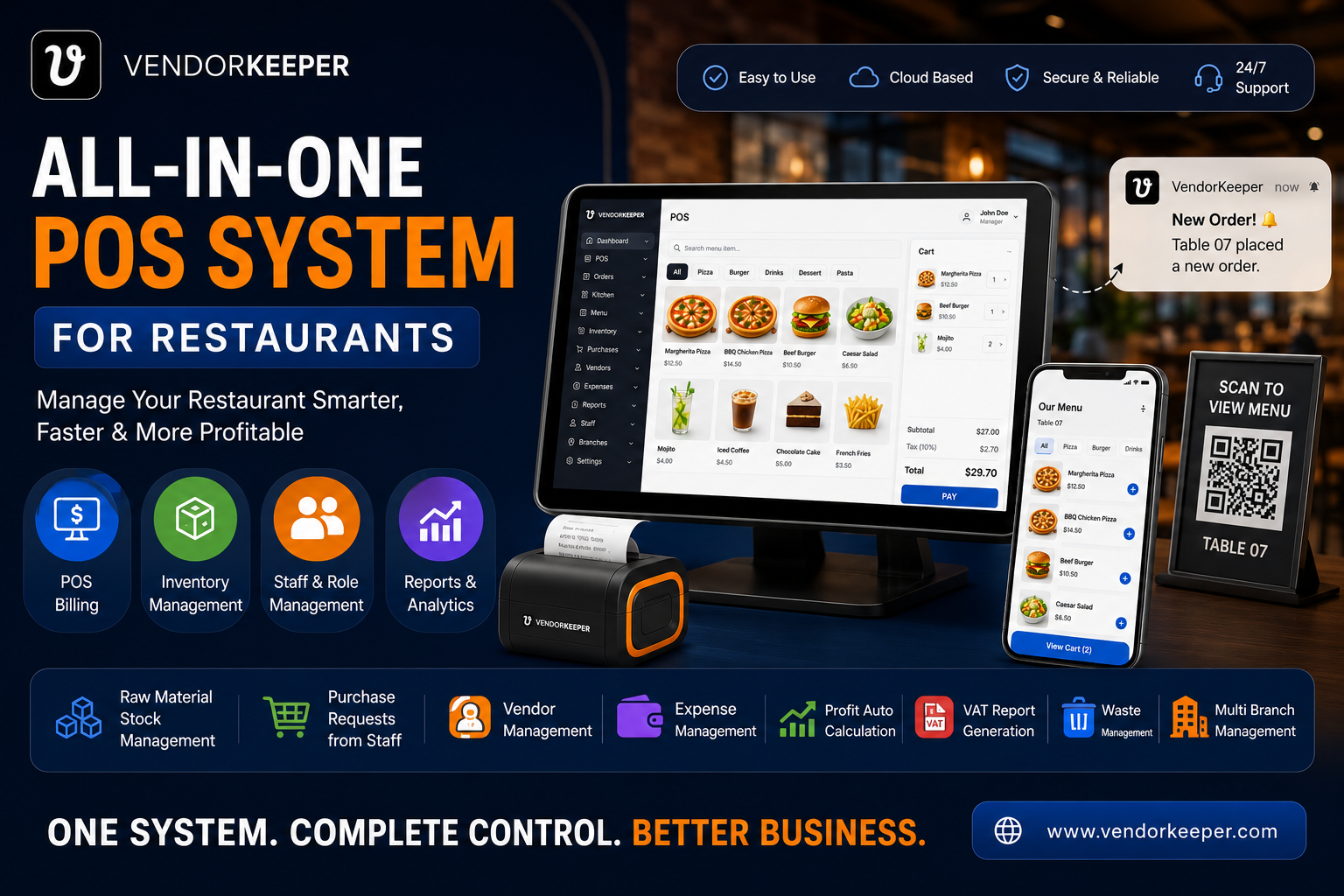
The debate between cloud POS vs traditional (legacy) POS is one of the most important decisions a restaurant owner faces in 2026. Get it wrong, and you are locked into expensive hardware, limited capabilities, and a vendor that charges you for every upgrade. Get it right, and your POS becomes a living, growing platform that improves your restaurant every week.
This guide provides an honest, comprehensive comparison — and explains why VendorKeeper's cloud-first approach represents the clear evolution of restaurant technology.
What is a Traditional (Legacy) POS?
Traditional restaurant POS systems — often called "on-premise" or "legacy" POS — run on dedicated hardware installed in your restaurant. The software runs locally on a server or terminal. Examples include older versions of Oracle MICROS, NCR Aloha, and early versions of Revel.
Characteristics of legacy POS:
- Software installed on local hardware (server, terminals)
- Data stored on-site — no cloud backup
- Requires physical IT maintenance and updates
- New features require expensive software upgrades
- Remote access is limited or non-existent
- High upfront hardware cost ($5,000–$50,000+ for enterprise installations)
What is a Cloud POS?
Cloud POS systems run on the internet — software is hosted on remote servers, data syncs in real time, and the system can be accessed from any device with a browser or app. Examples include Toast (hybrid), Square, and VendorKeeper.
Characteristics of cloud POS:
- Software hosted remotely — no local server required
- Automatic updates with new features
- Data accessible from any device, anywhere in the world
- Real-time sync across all terminals and branches
- Subscription-based pricing — lower upfront cost
- Built-in data backup and disaster recovery
Cloud POS vs Traditional POS: Head-to-Head
| Factor | Traditional POS | Cloud POS (VendorKeeper) |
|---|---|---|
| Upfront Cost | $5,000–$50,000+ | Low — subscription based |
| Hardware Required | Dedicated terminals/servers | Any Android/Windows device |
| Remote Access | Minimal/None | Full — any device, anywhere |
| Updates | Manual, costly, infrequent | Automatic, continuous |
| Data Backup | Manual/local | Automatic cloud backup |
| Multi-Branch | Complex, expensive | Centralised dashboard, standard |
| Offline Capability | Strong (local) | ✅ VendorKeeper: Full offline mode |
| Scalability | Expensive to expand | Instant — add branches online |
| Support | On-site required | Remote, 24/7 |
| Vendor Lock-in | High (proprietary hardware) | Low (standard hardware) |
The Offline Myth: Why Cloud POS Now Beats Legacy on Reliability
The most common argument for legacy POS is offline reliability: "If the internet goes down, my restaurant keeps running." This was a legitimate concern in 2015. In 2026, it is no longer a differentiating factor.
VendorKeeper's local-first architecture stores every transaction on the device first, then syncs to the cloud. This means:
- Billing continues 100% during internet outages
- All transactions sync automatically when connectivity returns
- Zero data loss — even during extended outages
- Kitchen displays continue operating locally
The offline argument for legacy POS is gone. Cloud POS now offers the same reliability — plus all the advantages of remote access, real-time analytics, and automatic updates.
The True Cost of Legacy POS
Legacy POS vendors are famous for making their systems look affordable upfront while hiding the real costs:
- Hardware: $5,000–$15,000 per location for terminals, servers, receipt printers, cash drawers
- Installation: $2,000–$5,000 per location
- Annual maintenance: 15–20% of software license cost
- Upgrades: Major version upgrades often cost $3,000–$10,000
- Multi-branch: Each branch requires its own hardware and licensing
A 5-branch restaurant group on a legacy system might spend $100,000+ over 5 years on hardware, maintenance, and upgrades — without getting any significant new features.
The same restaurant group on VendorKeeper pays a fraction of this — and gains QR ordering, real-time analytics, vendor management, and ingredient tracking that the legacy system could never offer.
When Might You Still Consider Legacy POS?
To be fair: there are niche scenarios where legacy POS remains relevant.
- No internet available at all: Remote locations with zero connectivity and no prospect of connectivity. However, VendorKeeper's offline mode eliminates this concern for 99% of operators.
- Extreme volume, specialised hardware: Very high-volume stadium concessions or casino dining may still use legacy hardware for specific throughput needs.
- Existing investment sunk: If you have recently invested $50,000+ in legacy infrastructure, the ROI calculation changes short-term.
For virtually every other restaurant scenario — from a single café to a 20-branch chain — cloud POS is the superior choice in 2026.
Migrating from Legacy POS to VendorKeeper
Migration is simpler than most operators expect:
- Export your menu from the legacy system (or re-enter in VendorKeeper's fast product setup)
- Install VendorKeeper on existing Android tablets or Windows devices — no new hardware required
- Configure your team with roles and permissions
- Go live — VendorKeeper is operational within hours of setup
Our team provides free onboarding support to ensure your migration from legacy POS to VendorKeeper is seamless.
FAQs: Cloud POS vs Traditional POS
Is cloud POS reliable enough for a busy restaurant? Yes. VendorKeeper's local-first architecture means billing is 100% functional offline. Cloud connectivity adds real-time sync and analytics — but is never a dependency for core billing operations.
What happens to my data if the cloud server goes down? VendorKeeper's cloud infrastructure uses enterprise-grade redundancy. Data is backed up continuously and is recoverable with zero data loss. Local transaction data is always preserved on the device.
Is cloud POS cheaper than traditional POS? Significantly cheaper over 3–5 years. No hardware server, no installation cost, no major upgrade fees, and no proprietary terminal purchases. VendorKeeper runs on Android and Windows devices you may already own.
How long does it take to switch from a legacy POS to VendorKeeper? Most restaurants are fully operational on VendorKeeper within 1–2 days of beginning setup — far faster than any legacy POS installation.