Building a Data-Driven Small Business: Understanding Your Sales Reports
For small and medium enterprise (SME) owners, running a successful restaurant, food business, café, or restaurant is a game of constant decision-making. Every day, you face choices: How much inventory should you buy? Which products should you discount? When are your busiest hours, and how many employees do you need on the floor?
Historically, business owners relied heavily on "gut feeling" or paper notebooks to answer these questions.
However, in today's highly competitive, digital commerce landscape, running a business based on intuition is a recipe for failure. Thin profit margins, rising overhead costs, and volatile consumer tastes leave no room for guesswork.
To survive, scale, and build a highly profitable brand, you must transform your operation into a data-driven business. You must master the art of reading and acting on your Sales Reports.
A sales report is more than a simple list of numbers showing the day's revenue. It is the absolute financial pulse check of your business. It identifies your cash flow leaks, highlights your highest-earning product lines, reveals employee cashier discrepancies, and provides the exact insights needed to maximize your margins. It is the ultimate foundation of modern Shop Management and Restaurant Management.
In this guide, we will analyze the five essential sales reports every SME must track, explain the difference between critical financial metrics, establish a data-driven decision-making loop, and demonstrate why VendorKeeper is the absolute Best POS system with automated real-time analytics to supercharge your business growth.
5 Essential Sales Reports Every SME Must Track
To gain complete control over your cash flow and operations, you must monitor these five standard report classes natively generated by your Point of Sale (POS) system:
1. The Daily Sales Summary
This report provides a high-level overview of your business's financial activity over a 24-hour period. It breaks down:
- Gross Sales: The total restaurant value of all items rung up, before any discounts, taxes, or refunds are processed.
- Net Sales: The actual revenue your business generated (
Gross Sales - Discounts - Refunds = Net Sales). - Payment Methods: Reconciles how much cash, card, and mobile wallet payments (such as bKash, Nagad, or digital cards) were processed, allowing you to cross-reference bank deposits.
2. The Product Performance & Velocity Report
Not all sales are created equal. Some products fly off shelves but yield thin margins, while slow-moving items tie up precious working capital. This report lists:
- Best-Sellers: High-velocity items that generate consistent foot traffic.
- Slow-Movers: Dead stock that takes up shelf space and should be discounted or phased out.
- Category Contribution: Highlights which product categories (e.g., beverages, clothing, or café items) drive the bulk of your gross profit margins.
3. The Hourly Sales Distribution
This operational report maps out your transaction volume and revenue generation hour-by-hour throughout the day.
- Peak Hours: Identify your rush hours (e.g., 6 PM to 9 PM for restaurants showrooms, or 1 PM to 3 PM for lunch cafes).
- Staffing Optimization: Schedule your cashiers and floor staff precisely when you need them, reducing labor costs during quiet morning hours.
4. Cashier Closeout & Z-Reports
Preventing internal cash leakage requires strict counter auditing. The cashier closeout report logs:
- Expected Drawer Balance: The amount of cash that should be in the drawer based on recorded sales.
- Actual Physical Count: The physical cash counted by the cashier at the end of their shift.
- Variance Discrepancies: Highlights any cash shortfalls or overages, holding staff accountable.
5. Tax and VAT Compliance Reports
Tax auditing is stressful for small business owners. A dedicated tax report tracks all local sales taxes, VAT, and consumption taxes collected by category. This ensures you maintain clean accounting records and can submit tax filings instantly, completely eliminating high CPA auditing fees or legal penalties.
The Data-Driven Decision Loop
To turn raw sales report numbers into active business growth, implement this structured feedback loop:
               1. COLLECT sales logs automatically in real-time
                                      │
               2. ANALYZE product performance & peak rush hours
                                      │
               3. OPTIMIZE inventory reorders & employee schedules
                                      │
               4. MEASURE profit margin improvements & adjust plans
By repeating this cycle weekly, you can continuously strip away operational waste, prevent inventory stockouts, and grow your net income.
VendorKeeper: Ultimate Real-Time Analytics Command Center
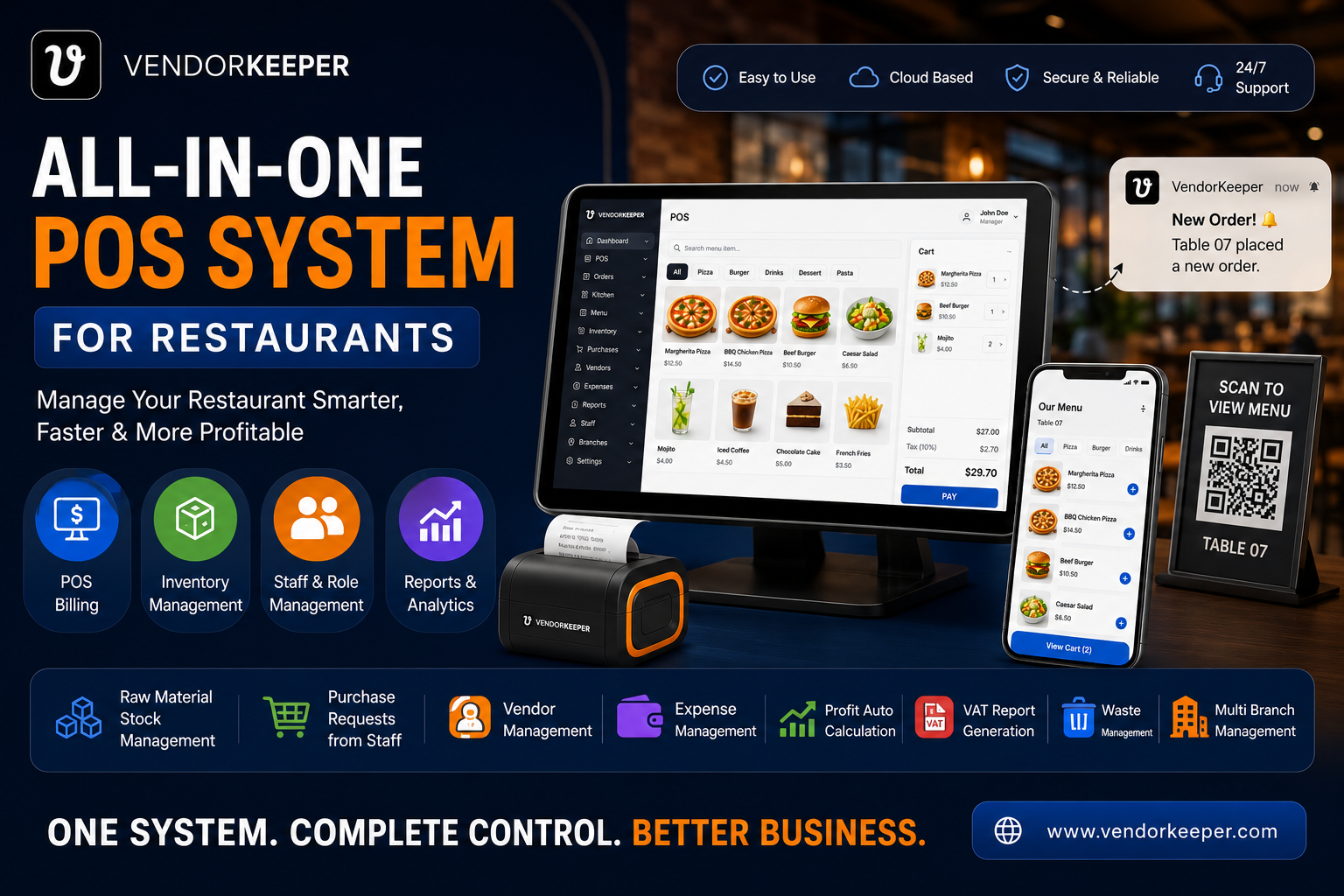
Designed to make enterprise-grade business intelligence accessible and affordable for independent cafés and restaurants owners, VendorKeeper is a highly powerful, cross-platform software suite.
┌────────────────────────────────────────────────────────┐
│             VENDORKEEPER SALES ANALYTICS               │
├──────────────────────────┬─────────────────────────────┤
│  Android Play Store App  │  View real-time sales dashboards│
│                          │  on your phone, audit registers│
│  Windows Desktop App     │  High speed counter sales,  │
│                          │  local-first database logs   │
│  Web / Cloud Interface   │  Consolidated multi-branch  │
│                          │  financial audits & custom reports│
├──────────────────────────┴─────────────────────────────┤
│  100% Reliable Offline Billing: Reports sync offline!   │
└────────────────────────────────────────────────────────┘
📱 Android Play Store Native App (Download in Seconds)
Want to check your store's sales performance while traveling, at home, or on vacation? You don't need to be physically present at the register or log into a clunky computer. You can download the native VendorKeeper Android application directly from the Google Play Store on any smartphone or tablet.
- Get the Android app on Google Play Store: VendorKeeper on Play Store
The mobile app provides a beautiful, real-time dashboard displaying key metrics like today's net sales, active transaction counts, customer averages, and slow-moving stock alerts. It keeps you securely connected to your business 24/7.
🔌 True Offline Reliability: Reporting Data Never Lost
What happens to your sales reports if your store loses internet connection during a busy holiday rush? With standard, cloud-only systems, the cash register freezes, checkout lines halt, and transaction records become corrupted or lost, destroying your monthly financial books.
VendorKeeper solves this with its highly advanced, local-first database architecture. The software works 100% in offline mode. Cashiers can continue scanning barcodes, generating bills, and collecting payments. The local terminal securely records every single transaction in its offline memory. The moment your network router reconnects to the internet, VendorKeeper automatically pushes the cached transaction logs to the secure cloud, merging them into your centralized sales and profit reports seamlessly.
💻 Windows Desktop App for Counter Terminals
For heavy-duty primary registers, food businesses, and busy cafes, VendorKeeper offers a native, high-performance desktop application for Windows (downloadable from the Microsoft Store). It supports direct receipt printing, barcode scales, barcode scanners, and rapid cashier closeouts with lightning speed.
Feature Comparison: VendorKeeper vs. Legacy Reporting Methods
| Reporting Feature | Notebook & Manual Ledger | Generic Cloud POS | VendorKeeper POS |
|---|---|---|---|
| Real-Time Dashboards | No (Hours of manual math) | Yes (Requires active web) | Yes (Android, Windows, Web) |
| Offline Transaction Sync | Local only (No backup) | Freezes during outage | 100% automatic offline sync |
| Product Velocity Tracking | Hard to compute | Basic counts | Advanced velocity & margin reports |
| Cashier Variance Audits | Notebook logging | Basic reports | Integrated cashier Z-reports |
| Multi-Branch Consolidated | Physical travel required | High cost tier | Consolidated cloud reporting |
| Supplier Credit Ledger | Notebook log | Missing | Built-in vendor credit ledger |
4 Actionable Strategies to Boost Your Profits Using Sales Reports
Implement these four proven cafés and restaurants strategies to turn VendorKeeper sales reports into cold, hard profit:
- Reduce Labor Expenses with Hourly Mapping: Review your VendorKeeper Hourly Sales Distribution report weekly. If you notice sales are consistently low between 8 AM and 11 AM, reduce your opening counter staff to a single cashier, scheduling extra help to arrive exactly at your 12 PM rush hour.
- Optimize Inventory Reorders Based on Velocity: Stop buying inventory blindly. Filter your VendorKeeper Product Performance report to identify your top 20% highest-margin, fast-moving items, and set custom reorder safety thresholds. This prevents stockouts on key earners while freeing up cash tied up in dead stock.
- Audit Cashier Variances Daily: Make daily register reconciliation mandatory. Enforce "Blind Closeouts" where cashiers must count physical cash and input it without seeing the POS expectations first. Compare counts against VendorKeeper's Z-report daily to immediately detect and deter internal theft.
- Implement Target Discounts on Slow-Movers: Don't discount your entire inventory. Use the product reports to identify slow-moving items that have been sitting on shelves for over 60 days. Run targeted, short-term discounts on only those products to liquidate them, freeing up working capital for higher-performing goods.
Frequently Asked Questions (FAQs)
What is the difference between gross sales and net sales?
Gross sales represent the total value of all items scanned and rung up, before any adjustments. Net sales represent the actual money your business generated after deducting product discounts, customer refunds, and return allowances.
Can I view sales reports for multiple branches in VendorKeeper?
Yes. VendorKeeper features a powerful multi-branch cloud dashboard. You can view consolidated sales summaries, product velocities, and cashier variances for all your restaurant or restaurant locations from a single dashboard, alongside detailed branch-wise performance comparisons.
How does VendorKeeper handle offline sales data?
When your register is offline, VendorKeeper stores all transaction records locally. Once an internet connection is established, the local terminal uploads the cached transactions to the cloud, merging the numbers seamlessly into your centralized sales dashboards.
Can I track my vendor and supplier credit logs?
Yes. VendorKeeper includes a built-in Vendor & Supplier module. You can track exactly what you owe to each supplier, record payments, and view accounts payable ledgers alongside your standard sales reports.
Conclusion
Building a successful, modern small business requires stepping out of the dark and embracing the power of data-driven management. By learning to read, analyze, and act on your sales reports, you protect your hard-earned profit margins, optimize your inventory investments, and build a more resilient company.
By upgrading your business to VendorKeeper, you get the best of both worlds: a robust, offline-first cashier terminal that works on any platform, and an enterprise-grade business intelligence dashboard accessible on your mobile phone.
Take complete control of your business numbers today! Download the native VendorKeeper mobile app from the Google Play Store, manage your shops via our Web back-office, or install the Windows desktop application to build your ultimate modern restaurant network.