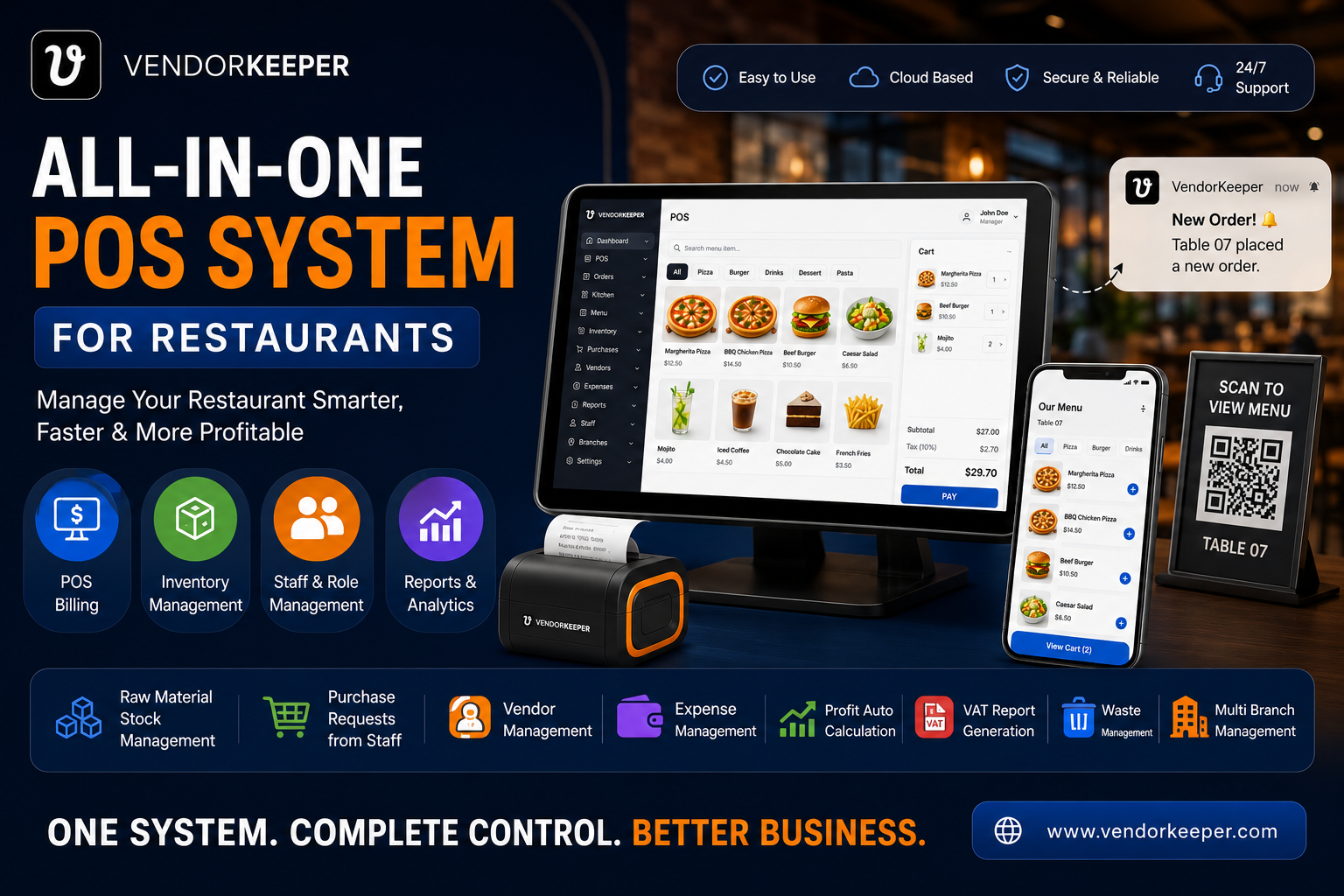
America's restaurant industry generates over $1 trillion in annual revenue — but nearly 60% of independent restaurants close within their first year, and the #1 operational reason is not bad food. It is poor financial control, inventory blind spots, and fragmented technology.
The US restaurant market is flooded with POS options. Square, Toast, Clover, Lightspeed, TouchBistro — the list is long and the marketing is loud. But most of these systems solve only one part of the problem. This guide cuts through the noise and explains exactly what the best restaurant POS software for US restaurants looks like in 2026 — and why VendorKeeper is the full-stack answer that American operators are discovering.
What US Restaurants Are Getting Wrong About Their POS
Most American restaurant owners evaluate POS systems on three criteria: price, hardware compatibility, and how fast it can process a credit card. These matter — but they represent only the surface of what a POS should do.
The hidden costs that are eating American restaurant margins:
- 28–35% food cost driven by over-ordering and untracked waste
- Staff theft and unauthorised discounts because permissions are poorly configured
- Vendor overspending because purchase orders are not tracked or approved
- Multi-location chaos because each branch runs its own disconnected system
- Compliance gaps in sales tax documentation and financial reporting
A truly great restaurant POS for the US market addresses every one of these — not just card processing speed.
Core Features US Restaurant Operators Need
Cloud-Based Anywhere Access
US restaurant groups increasingly operate across multiple states or cities. Cloud-based POS with real-time sync means the owner in New York can see live sales from the Los Angeles branch on their phone during service.
VendorKeeper's cloud architecture delivers sub-second sync across unlimited branches. Every transaction, stock movement, and staff action is visible in real time — from any device, anywhere.
Inventory Tracking Down to the Ingredient Level
A burger costs $2.40 in ingredients. If your system only tracks finished products, you have no idea whether your kitchen is wasting $0.30 or $0.80 per burger. Multiply that by 400 covers a night and the math is brutal.
VendorKeeper tracks raw materials and ingredients — not just menu items. Every time a dish is sold, the precise ingredient quantities are deducted automatically from stock. Food cost is calculated in real time, with no spreadsheet required.
POS with Integrated Vendor Purchase Workflows
American restaurants spend an average of 28–35% of revenue on food and beverage purchasing. Yet most POS systems have zero tools for managing this spend. You need purchase order management, vendor invoice tracking, and approval workflows.
VendorKeeper's vendor module lets staff submit digital purchase requests, which route to management for approval before a PO is issued. No more unauthorised orders. No more duplicate deliveries. Every supply dollar is tracked and approved.
Multi-Location Dashboard for US Chains
From a regional chain of 8 to a national franchise of 80 — VendorKeeper's multi-branch dashboard gives operators a centralised view of every location. Compare sales performance, identify underperforming branches, and drill down into stock or staff data for any individual location.
QR Self-Ordering — The Post-COVID Expectation
US diners now expect the option to order from their phone. VendorKeeper's QR menu ordering gives every table its own scannable code linked to your digital menu. Guests order directly; the kitchen receives the ticket instantly. Average order value increases 15–20% because guests browse without time pressure.
Sales Tax Documentation & Financial Reporting
US restaurants must document sales by tax category for state and local compliance. VendorKeeper's reporting module generates detailed sales reports by category, time period, and location — exportable to PDF and Excel for your accountant.
VendorKeeper vs US-Market Competitors
| Feature | Toast | Square | Clover | VendorKeeper |
|---|---|---|---|---|
| Ingredient-level inventory | ⚠️ Add-on | ❌ | ❌ | ✅ Core |
| Vendor purchase approval | ❌ | ❌ | ❌ | ✅ Core |
| QR self-ordering (native) | ❌ | ❌ | ❌ | ✅ Core |
| Offline billing | ⚠️ Limited | ⚠️ Limited | ⚠️ Limited | ✅ Full |
| Multi-branch (all plans) | ✅ Enterprise | ❌ | ❌ | ✅ All Plans |
| Windows / Microsoft Store | ❌ | ❌ | ❌ | ✅ |
| Waste & damage tracking | ❌ | ❌ | ❌ | ✅ Core |
Best Use Cases for US Restaurants
Independent Restaurants (NYC, LA, Chicago): VendorKeeper's cost-efficient all-in-one stack replaces 4–5 separate tools (POS + inventory + vendor + reporting + staff management) with one system.
Regional Chains (Southeast, Midwest, West Coast): The multi-branch dashboard eliminates the "franchise chaos" of disconnected systems across locations.
Food Halls & Ghost Kitchens: VendorKeeper's QR ordering and delivery mode support the non-traditional restaurant formats that are reshaping American dining.
Hotel Restaurants & Resorts: Table management, fine-dining KOT workflows, and multi-concept support (coffee shop + restaurant + bar) in a single system.
FAQs: Restaurant POS for USA
What is the best POS system for US restaurants in 2026? For full-stack coverage — billing, inventory, vendor management, and multi-branch — VendorKeeper outperforms Toast and Square by including all these capabilities as core features, not expensive add-ons.
Does VendorKeeper work for American sales tax? Yes. VendorKeeper supports configurable tax rates by item category — accommodating the complex, state-by-state and county-by-county US sales tax structure.
What is the cheapest restaurant POS for a US small business? VendorKeeper offers the lowest effective total cost because it eliminates the need for separate inventory, vendor management, and analytics subscriptions. Contact us for US-specific pricing.
Can a restaurant in the US use VendorKeeper without proprietary hardware? Yes. VendorKeeper runs on Android tablets, Windows laptops/PCs (Microsoft Store), and any web browser — no proprietary terminals or iPad purchases required.