How to Choose the Best POS System for Food Businesses and Food Businesses
Running a food business or a food business is one of the most operationally intense food business models. Unlike a standard café that may manage a few hundred clothing items, a typical neighborhood food business or mid-sized food business routinely handles anywhere from 5,000 to over 20,000 unique Menu Items (Stock Keeping Units). From fresh vegetables sold by weight, dairy products with strict expiration dates, to packaged foods, cleaning supplies, and local wholesale goods—every single item must be tracked, priced, and accounted for in real-time.
To run a food business successfully without losing profits to waste, shrinkage, or slow checkouts, you need a highly specialized Food POS system. It must act as a complete Shop Management command center.
In this comprehensive guide, we will explore the unique challenges of managing a food business, outline the must-have features of a food business POS, and explain why VendorKeeper is the absolute Best POS system to streamline your operations, protect your margins, and keep your queues moving.
The Unique Challenges of Food & Food Business Operations
Before choosing your software, it is vital to outline the daily bottlenecks that food owners face. A standard, generic Restaurant POS system that is built for basic clothing restaurant will quickly fall short in a high-volume food environment due to three key challenges:
1. Extremely High Transaction Volumes and Long Lines
During rush hours—typically in the evenings when customers stop by after work—a food business experiences rapid transaction volume. Cashiers must scan items, process payments, and bag goods in seconds. If a barcode fails to scan or a POS takes more than three seconds to process a transaction, lines build up, creating customer frustration and lost sales.
2. Expiration Date and Perishable Goods Management
A massive profit drain in food businesses is "spoilage"—dairy, bakery, and fresh produce items that go bad before they are sold. Without automated batch tracking and expiration alerts, expired goods sit on shelves, leading to customer complaints or food safety violations, while stock that should have been sold is thrown in the trash.
3. Loose Goods and Fractional Quantity Selling
Many ingredients are sold by weight rather than by individual packet (e.g., rice, lentils, onions, meat). Your POS must support fractional quantities (e.g., selling 1.34 kg of rice) and integrate seamlessly with weighing scale barcodes to calculate prices accurately.
Must-Have Features in a Food Business & Food POS
To overcome these hurdles, the Best POS system for a food business must include these specialized capabilities:
✅ Sub-Second Barcode Scanning
The checkout interface must be highly optimized for keyboard shortcuts and barcode scanners. Cashiers should be able to scan item after item continuously without needing to touch the mouse or tap multiple screens to complete a basic sale.
✅ Expiration & Batch Tracking
The system should allow you to record batch numbers and expiration dates during stock intake. The POS software should actively alert managers when a specific batch is approaching its expiration date, enabling them to apply quick promotional discounts to sell those items before they spoil.
✅ Built-in Weight Scale Support
The POS must natively handle weighted items, either by reading the weight directly from an electronic scale connected via serial/USB, or by decoding price-embedded barcodes generated by standalone weighing scales.
✅ Detailed Purchase Orders and Supplier Ledgers
Because ingredients rely on dozens of local distributors and wholesalers, your system must have built-in vendor tracking. It must record what inventory you ordered, what has been delivered, how much credit is owed to which supplier, and when payment is due.
VendorKeeper: The Ultimate Multi-Platform Food POS System
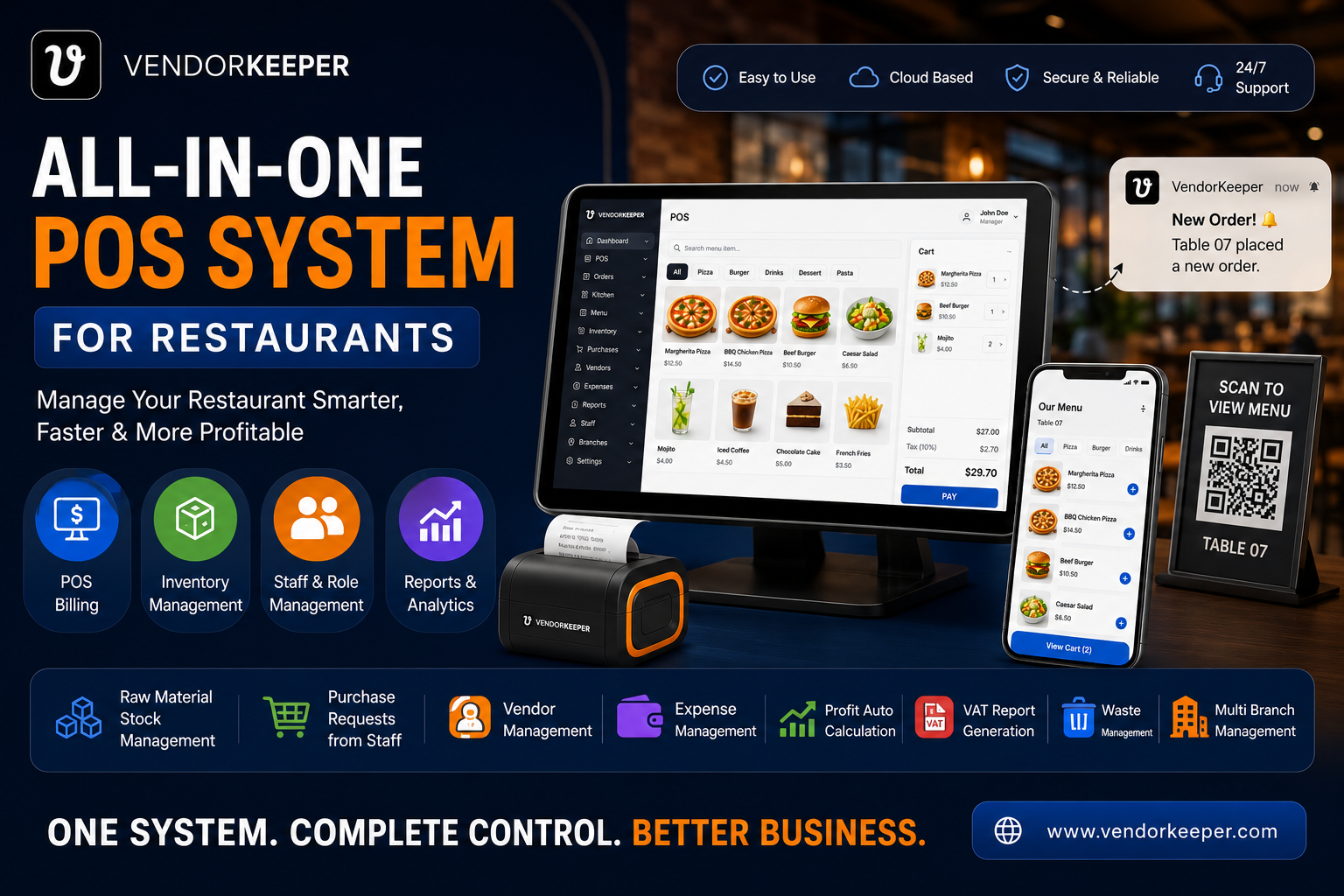
Designed with the needs of high-speed, high-volume restaurant in mind, VendorKeeper is the ultimate software suite for food businesses and food businesses. It simplifies complex Menu Item management and ensures your checkout counters run smoothly.
┌────────────────────────────────────────────────────────┐
│               VENDORKEEPER FOR INGREDIENTS               │
├──────────────────────────┬─────────────────────────────┤
│  Android Play Store App  │  Turn any phone into a POS  │
│  Windows Desktop App     │  Perfect for large counters  │
│  Web / Cloud Interface   │  Back-office store management│
├──────────────────────────┴─────────────────────────────┤
│  Zero Internet Required: Offline billing works 24/7!   │
└────────────────────────────────────────────────────────┘
📶 100% Reliable Offline Billing (No Internet? No Problem!)
In many markets, internet connectivity is subject to unexpected downtime, slow speeds, or weather outages. In a busy food business, an internet outage cannot mean shutting down your registers.
VendorKeeper features a robust, local-first database architecture. The app is designed to work fully in offline mode. Cashiers can continue scanning, billing, calculating taxes, and printing receipts even if the internet router is completely unplugged. All transactions are securely written to the device's local memory and will automatically sync to your cloud-based centralized sales reports as soon as the internet returns.
📱 Android Play Store Availability
Want to empower your floor staff to check stock prices, update inventory levels directly from the aisles, or set up a secondary mobile checkout line during peak holiday hours? VendorKeeper is fully available as a native, lightweight, and robust Android app.
- Download the official Android app: VendorKeeper on Google Play Store
💻 Windows & Web Apps for Heavy-Duty Counters
For primary cashier counters that use barcode scanners, heavy-duty receipt printers, cash drawers, and customer-facing displays, VendorKeeper offers a native, high-performance desktop application for Windows (available on the Microsoft Store) as well as an advanced cloud platform accessible on any Web browser. This gives you complete flexibility to choose the hardware that fits your budget—from budget-friendly Windows laptops to dedicated restaurant checkout terminals.
Why Food Businesses Prefer VendorKeeper: Feature Comparison
| Feature Capability | Legacy Cash Register | Generic Cloud-Only POS | VendorKeeper POS |
|---|---|---|---|
| High Menu Item Counts (10,000+) | Extremely slow | Slows down interface | Optimized local-database indexing |
| Offline Reliability | Local only (no backup) | Freezes during outages | Seamless offline-to-cloud auto-sync |
| Android Integration | No | iPads only (expensive) | Free Android app on Play Store |
| Fractional Weights | Manual entry | Hard to configure | Natively supported (e.g., 0.25 kg) |
| Supplier Balances | Paper journals | Missing or expensive add-on | Integrated vendor & credit ledgers |
| Multi-store Stock Transfer | Impossible | Complex setup | One-click branch transfer & tracking |
Best Practices for Managing Food Inventory
To squeeze maximum profit out of your food business or food business using VendorKeeper, implement these proven inventory strategies:
- Implement FIFO (First In, First Out): Always place older stock at the front of the shelves and newer arrivals at the back. VendorKeeper's batch tracking helps you identify which items need to be pushed first.
- Utilize Reorder Points: Do not wait until you completely run out of milk or rice to order more. Set low-stock thresholds in VendorKeeper so the system automatically alerts you to place a new wholesale order.
- Run "Sales Reports" Weekly: Check your VendorKeeper analytics to discover which food brands or items are generating the highest profit margins, and allocate more shelf space to those premium products.
- Log Spoilage and Theft Immediately: When fruit goes bad or an item is damaged, log it in VendorKeeper as "waste." This keeps your theoretical stock aligned with physical reality and prevents errors in your tax reports.
Frequently Asked Questions (FAQs)
What is the best POS system for a small food business?
VendorKeeper is highly recommended as the best POS system for a small food business. Because it runs on existing Android tablets, smartphones, and Windows computers, small restaurant owners do not need to invest thousands of dollars in proprietary POS hardware. Additionally, its offline mode ensures that sales never stop, even during power cuts or internet outages.
How does a food POS handle items sold by weight?
A high-quality food POS like VendorKeeper supports fractional quantity sales. You can enter products with unit types like "kg," "gram," or "liter" and sell them in decimal amounts (such as 0.75 kg of chicken or 1.5 kg of sugar), with the software automatically calculating the exact price based on your defined per-unit rate.
Can I run my food business POS without an active internet connection?
Yes. VendorKeeper's offline mode stores all product records and transactional data locally on your computer, tablet, or phone. It allows you to run complete checkouts, print bills, and manage inventory without any active internet connection. Once your internet is restored, all data automatically syncs back up to the cloud.
How do I import my existing product list into VendorKeeper?
VendorKeeper provides a convenient bulk-upload tool. You can compile your thousands of food products, wholesale costs, retail prices, barcodes, and stock levels into a standard CSV or Excel template, and upload the entire list to the system in a single click.
Conclusion
Succeeding in the highly competitive food and food business industry requires operational excellence. You cannot afford to lose margins to expired stock, slow checkouts, or internet outages.
By investing in a robust, multi-platform, and offline-capable Food POS system like VendorKeeper, you gain absolute control over your inventory, suppliers, and cash flow. Download the VendorKeeper Android application from the Google Play Store today, or set up our Windows and Web applications to transform your local shop into a highly optimized, modern restaurant powerhouse!