Fast food and Quick Service Restaurants (QSR) operate on a ruthless economics model: low margins, high volume, brutal speed requirements. A 10-second delay per customer during a lunch rush translates to 30 fewer covers per hour. Across a year, that is tens of thousands of dollars in lost revenue.
Choosing the right POS system for fast food restaurants is not about features — it is about speed, reliability, and the intelligence to optimise your most expensive resources: food and labour.
This guide covers everything QSR operators need to know about selecting a POS in 2026 — and why VendorKeeper is built for the pace of fast service.
What Makes a QSR POS Different from a Full-Service POS
Quick service restaurants have unique operational demands:
- Orders are placed at the counter, not the table — the billing interface must be lightning-fast
- Kitchen fulfillment must be real-time — a 2-minute ticket time requires instant order transmission
- Peak hours are brutal — the POS must handle 200+ transactions/hour without lag
- Food cost control is critical — at 28–32% food cost, any waste directly destroys margin
- Multiple payment types — cash, card, QR pay, meal vouchers, loyalty points
Generic POS systems built for full-service restaurants often buckle under QSR volume. You need a system that was engineered for speed from the ground up.
Core Features for Fast Food & QSR POS Systems
Sub-Second Barcode Scanning & Item Lookup
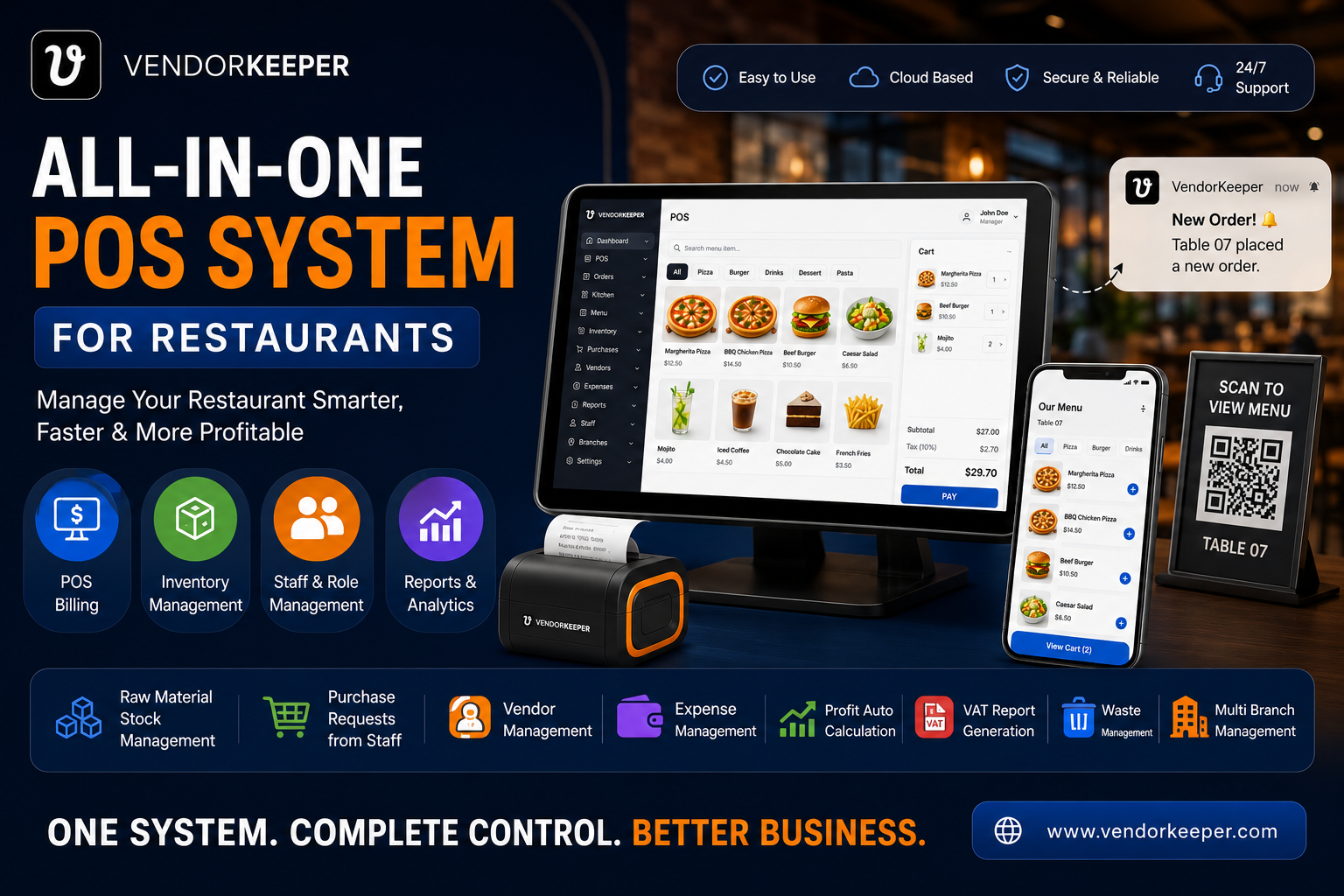
VendorKeeper's QSR billing interface is designed for speed above all else. Items can be added via barcode scan, search, or category tap. Popular items are front-and-centre. Modifiers and upsells appear in one tap. A skilled cashier can complete a 5-item order in under 20 seconds.
Kitchen Order Ticket (KOT) — Instant Transmission
The moment a cashier hits "confirm," the Kitchen Order Ticket appears on the kitchen display. No paper. No shouting. No lost tickets. Every order is timestamped and sequenced — ensuring the kitchen works the queue in order and tracks ticket times.
Restaurants using VendorKeeper's KOT system report average ticket time reductions of 30–35% compared to verbal or paper-based order communication.
Multiple Payment Methods in One Transaction
QSR customers pay with cash, Visa, Mastercard, bKash, Nagad, Apple Pay, Google Pay, and meal vouchers — sometimes in combination. VendorKeeper's split payment support handles any combination of payment methods in a single transaction without slowing the queue.
Discount & Combo Management
Flash deals, combo meals, loyalty discounts, student discounts, happy-hour pricing — QSRs run promotions constantly. VendorKeeper's discount and coupon engine applies the right price to the right item automatically. No manual overrides. No cashier errors.
Offline Billing — Queue Never Stops
An internet outage during the lunch rush at a busy QSR is catastrophic — unless your POS handles it gracefully. VendorKeeper's local-first architecture means billing continues without interruption during network issues. All transactions sync when connectivity returns.
Inventory Control: Where QSR Profits Are Actually Made
Automatic Ingredient Deduction
At QSR volumes — 500+ covers per day — even a 1% food waste rate represents significant dollar losses. VendorKeeper tracks raw materials at the ingredient level: every burger bun, every sauce packet, every portion of protein is deducted from stock automatically with every sale.
Low Stock Alerts Before You Run Out
VendorKeeper fires instant alerts when any ingredient falls below your set minimum. The manager gets a notification on their phone during service — before the kitchen runs out of patties at 12:30 PM.
Waste & Damage Logging
Every item discarded — burned fries, dropped portions, expired ingredients — is logged against a waste category. This data feeds directly into your food cost calculation, giving you an honest picture of true operational efficiency.
VendorKeeper for Fast Food Chains & Franchises
Franchise Multi-Branch Dashboard
Running 5 QSR outlets across a city? VendorKeeper's centralised multi-branch dashboard gives franchise owners a live view of every location: sales by hour, top-selling items, stock levels, and staff activity.
Staff & Permission Management
QSR environments have high staff turnover and strict permission requirements. Cashiers process payments. Shift managers apply discounts. Only owners see the financials. VendorKeeper's role-based access control enforces these boundaries automatically.
Best-Selling Item Analytics
Know which burger sells most at 11 AM versus 7 PM. Know which combo converts the most add-ons. VendorKeeper's real-time analytics dashboard gives QSR operators the data to optimise menus, promotions, and labour scheduling.
Top QSR Scenarios Where VendorKeeper Excels
Food Courts: High transaction volume, multiple cashier stations, centralised kitchen — VendorKeeper handles concurrent billing across multiple terminals with shared kitchen display.
Counter Service Chains: Clean billing interface, fast item lookup, KOT integration, and shift-based reporting make counter service seamless.
Drive-Through: VendorKeeper's mobile-friendly interface supports tablet-based ordering at the drive-through window, with instant kitchen transmission.
Ghost Kitchens / Dark Kitchens: Delivery order mode with real-time kitchen tracking and ingredient deduction for every order.
FAQs: POS for Fast Food Restaurants
What is the best POS system for fast food restaurants? VendorKeeper is purpose-built for QSR speed — sub-second item lookup, instant KOT, split payment, offline billing, and ingredient-level inventory — all in one system available on Android, Windows, and Web.
Does VendorKeeper support drive-through ordering? Yes. VendorKeeper's tablet-friendly interface and instant kitchen transmission support drive-through workflows.
How does KOT help fast food restaurants? Kitchen Order Tickets eliminate verbal miscommunication, sequence orders by time, and display clear fulfilment status — reducing average ticket time by 30–35%.
Can VendorKeeper handle 500+ transactions per day? Yes. VendorKeeper's local-first architecture handles high transaction volumes without cloud latency — critical during peak QSR service periods.